---
title: "Wet vs. Dry Concrete Grinding and Polishing: Which Method Is Right for the Job?"
description: Compare wet and dry concrete grinding and polishing, including dust and slurry control, diamond-tooling life, cleanup, finish quality, and jobsite considerations.
image: https://blog.aramsco.com/hubfs/Copy%20of%20containment%20blog.png
---
- [Home](https://aramsco.com)
- [Pro's Corner](https://blog.aramsco.com)
[](https://www.aramsco.com/)
- [Home](https://aramsco.com)
- [Pro's Corner](https://blog.aramsco.com)
- Account
- [locations](http://aramsco-live.epicorcommerce.com/locations/)
- [education](http://aramsco-live.epicorcommerce.com/education/)
- [about us](http://aramsco-live.epicorcommerce.com/aboutus/)
# Pro's Corner
## [Wet vs. Dry Concrete Grinding and Polishing: Which Method Is Right for the Job?](https://blog.aramsco.com/wet-vs.-dry-concrete-grinding-and-polishing-which-method-is-right-for-the-job)
Posted by Aramsco Technical Staff on Jul 24th 2026
Wet vs. Dry Concrete Grinding and Polishing: Which Method Is Right for the Job?
7:09
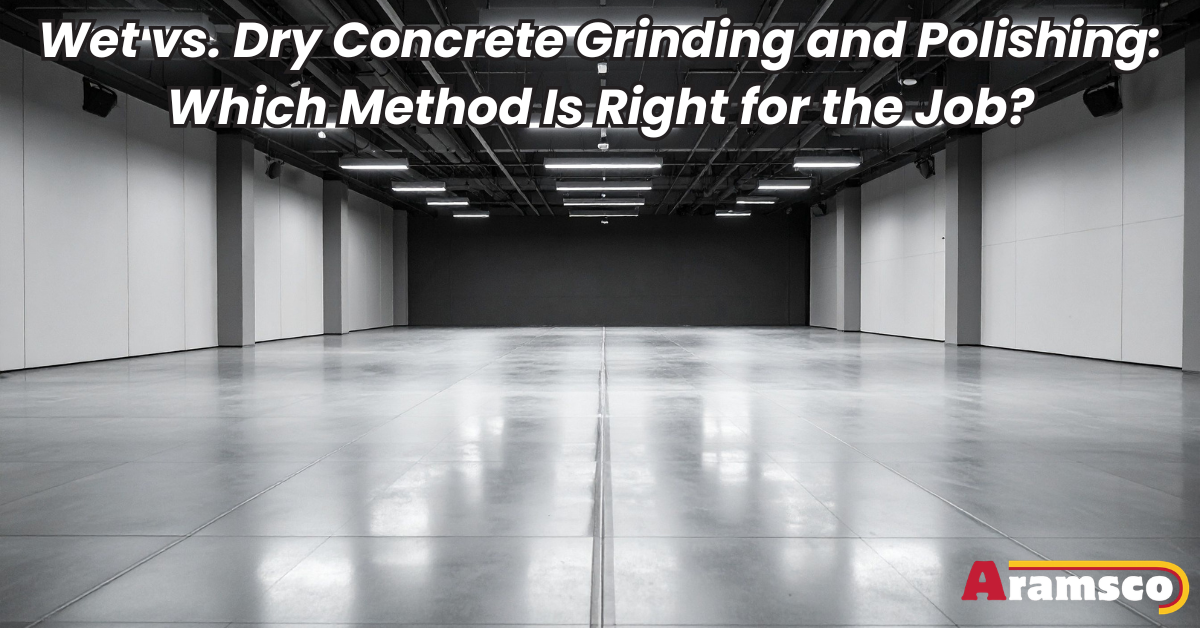
Anyone who has researched concrete grinding or polishing has probably come across the terms “wet” and “dry.” These terms describe the two primary ways contractors grind and polish concrete floors.
Although some contractors strongly prefer one method over the other, neither approach is automatically the right choice for every project. Each has advantages and disadvantages, and the best option will depend on the concrete, the desired finish, the jobsite conditions, and the equipment being used.
In many cases, contractors may even use a combination of wet and dry processing to achieve the best result. Below, we look at how each method works and when one may be more appropriate than the other.
## How Dry Concrete Grinding and Polishing Works 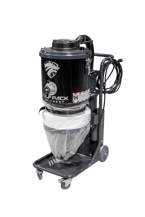
Dry concrete grinding and polishing has become increasingly popular. Many modern [concrete grinders and polishers](https://www.aramsco.com/equipment-instruments/grinders-polishers/machines.html) are designed to connect directly to a compatible [dust-collection system](https://www.aramsco.com/equipment-instruments/vacuums/vacuums-dust-collectors.html?utm_source=chatgpt.com).
Grinding concrete without water produces dust. For that reason, an appropriately sized dust collector is an essential part of a dry grinding setup. It helps capture dust as it is generated, limits the amount released into the surrounding work area, and makes cleanup more manageable.
The filtration and airflow requirements will depend on the grinder, the work environment, and the applicable silica-control requirements. Contractors should always follow the equipment manufacturer’s instructions and their required exposure-control plan.
When the grinder and dust collector are properly matched, dry processing can provide a cleaner and more efficient workflow. Because the surface does not need time to dry, the operator can also see the condition of the concrete and evaluate the performance of the diamond tooling as the work progresses.
## How Wet Concrete Grinding and Polishing Works
Wet grinding and polishing is the older and more traditional of the two methods. Many contractors continue to use it because it has proven effective across a wide range of concrete applications. 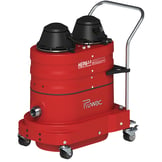
During wet grinding, water is continuously introduced to the surface. The water helps lubricate and cool the diamond tooling while also suppressing much of the airborne dust produced by the grinding process.
Instead of dry dust, wet grinding creates slurry—a mixture of concrete particles and water that forms a wet paste on the floor. That slurry must be collected and disposed of properly. A dedicated slurry vacuum, such as the [Ruwac Slurry Pro vacuum with return pump](https://www.aramsco.com/2632-0616-ruwac-h32g201p-slurry-pro-2-motor-110v-vacuum-w-return-pump-10-x-1-5-pump-drain-hose-32-gallon-capacity-floor-sweep-sold-separately-201362.html?utm_source=chatgpt.com), can help make the collection process more efficient.
Wet processing still requires a cleanup plan, but it can greatly reduce the amount of concrete dust that becomes airborne. OSHA recognizes integrated water-delivery systems and manufacturer-recommended vacuum dust-collection systems as control methods for walk-behind floor grinders.
## Is Wet or Dry Concrete Grinding Better?
There is no single answer that applies to every project. Wet and dry grinding each have strengths and limitations, and the right choice depends on the job.
Concrete hardness, tooling selection, water availability, dust-control requirements, cleanup procedures, and the desired level of gloss can all influence the decision. Some floors can be completed entirely wet or entirely dry, while others may benefit from using both methods at different stages.
Here are the most important advantages and disadvantages to consider.
## Pros and Cons of Wet Concrete Grinding and Polishing
### Advantages of Wet Grinding
- **It can extend the life of diamond tooling.** Water helps cool the tooling during operation, reducing the possibility of excessive heat buildup.
- **It greatly reduces airborne dust.** Much of the concrete dust becomes contained in the slurry instead of entering the surrounding air.
- **It is a proven process.** Contractors have successfully used wet grinding and polishing methods for many years.
- **It can help on particularly hard concrete.** The added cooling and lubrication may help diamond tooling continue cutting when a dry process would generate too much heat.
### Disadvantages of Wet Grinding
- **It can consume a significant amount of water.** Water usage can become an important consideration on larger projects.
- **It may produce less gloss than a dry finishing process.** Contractors seeking the highest possible shine may choose to complete the later polishing stages dry.
- **Slurry cleanup can be messy.** The slurry must be collected, contained, and disposed of according to applicable requirements.
- **The surface must dry before it can be fully evaluated.** This can make it more difficult to see the immediate results of each tooling step.
## Pros and Cons of Dry Concrete Grinding and Polishing
### Advantages of Dry Grinding
- **It can produce a higher-gloss finish.** Dry polishing is often selected for the final stages when maximum clarity and shine are priorities.
- **It is often suitable for softer concrete.** Dry tooling can perform effectively on concrete where excessive water may make the process more difficult to manage.
- **Cleanup can be more efficient.** A properly matched dust collector captures material while the grinder is operating.
- **Results are immediately visible.** Because the floor is already dry, operators can quickly determine whether the tooling is cutting effectively.
- **There is no slurry to manage.** Eliminating slurry can simplify jobsite cleanup and disposal.
### Disadvantages of Dry Grinding
- **Dust must be carefully controlled.** Grinding concrete can release respirable crystalline silica, making an effective exposure-control system essential.
- **Additional equipment is required.** Contractors must account for the cost of a compatible dust collector, hoses, filters, bags, and related accessories.
- **Diamond tooling can glaze over.** If the tooling becomes too hot, particularly on hard concrete, the diamonds may stop cutting effectively.
- **The grinder and dust collector must be properly matched.** Insufficient airflow or an incorrect setup can reduce dust-capture performance.
## Finding the Right Balance for Your Project
Ultimately, the best method is the one that fits the concrete and the conditions of the job.
In many situations, using both wet and dry processing provides the most effective solution. For example, a contractor working with extremely hard concrete may begin with wet grinding to keep the diamond tooling cool and cutting efficiently. Once the initial grinding stages are complete, the contractor may transition to dry polishing to achieve greater clarity and shine.
Other projects may be completed successfully using only one method. Before starting, consider the hardness of the concrete, the selected tooling, the desired finish, access to water and power, the dust- or slurry-management plan, and the amount of cleanup the site can accommodate.
Neither wet nor dry processing is universally better. Understanding the advantages and limitations of both methods allows contractors to choose the most productive approach for each floor.
*Visit our [website](https://aramscosurface.com/) to learn more about Aramsco Surface.*
[Aramsco Surface](https://blog.aramsco.com/tag/aramsco-surface)
- [Tweet](https://twitter.com/share)
[**BLOG HOME**](https://blog.aramsco.com/)
**Where the professionals go to learn about:**
- lead and asbestos abatement
- professional cleaning
- mold, fire, and water restoration
- concrete surface preparation
- business management
### Subscribe to Blog
Search Search Google
### Recent Posts
### Posts by Topic
- [Business (41)](https://blog.aramsco.com/tag/business)
- [Aramsco Clean (36)](https://blog.aramsco.com/tag/aramsco-clean)
- [Aramsco Restore (29)](https://blog.aramsco.com/tag/aramsco-restore)
- [carpet cleaning (27)](https://blog.aramsco.com/tag/carpet-cleaning)
- [Chemistry (19)](https://blog.aramsco.com/tag/chemistry)
- [Rugs (14)](https://blog.aramsco.com/tag/rugs)
- [Aramsco Surface (12)](https://blog.aramsco.com/tag/aramsco-surface)
- [Carpet (12)](https://blog.aramsco.com/tag/carpet)
- [target marketing (11)](https://blog.aramsco.com/tag/target-marketing)
- [Concrete (10)](https://blog.aramsco.com/tag/concrete)
- [Education (9)](https://blog.aramsco.com/tag/education)
- [deodorization (9)](https://blog.aramsco.com/tag/deodorization)
- [special agents (9)](https://blog.aramsco.com/tag/special-agents)
- [upholstery cleaning (9)](https://blog.aramsco.com/tag/upholstery-cleaning)
- [Carpet Presprays (8)](https://blog.aramsco.com/tag/carpet-presprays)
- [Tile & Grout (8)](https://blog.aramsco.com/tag/tile-grout)
- [customer service (8)](https://blog.aramsco.com/tag/customer-service)
- [encapsulation (8)](https://blog.aramsco.com/tag/encapsulation)
- [COVID-19 (7)](https://blog.aramsco.com/tag/covid-19)
- [Spotting (7)](https://blog.aramsco.com/tag/spotting)
- [Stain Removal (7)](https://blog.aramsco.com/tag/stain-removal)
- [Surface Preparation (6)](https://blog.aramsco.com/tag/surface-preparation)
- [Business Finance (5)](https://blog.aramsco.com/tag/business-finance)
- [Customer communication and storytelling (5)](https://blog.aramsco.com/tag/customer-communication-and-storytelling)
- [Grow your business (5)](https://blog.aramsco.com/tag/grow-your-business)
- [carpet protector (5)](https://blog.aramsco.com/tag/carpet-protector)
- [Equipment (4)](https://blog.aramsco.com/tag/equipment)
- [Flooring (3)](https://blog.aramsco.com/tag/flooring)
- [concrete surface preparation (3)](https://blog.aramsco.com/tag/concrete-surface-preparation)
- [sales (3)](https://blog.aramsco.com/tag/sales)
- [IICRC Classes (2)](https://blog.aramsco.com/tag/iicrc-classes)
- [Restoration (2)](https://blog.aramsco.com/tag/restoration)
- [Targeted Marketing (2)](https://blog.aramsco.com/tag/targeted-marketing)
- [Trauma Cleaning (2)](https://blog.aramsco.com/tag/trauma-cleaning)
- [Truckmount (2)](https://blog.aramsco.com/tag/truckmount)
- [carpet coloring (2)](https://blog.aramsco.com/tag/carpet-coloring)
- [Aramsco Service (1)](https://blog.aramsco.com/tag/aramsco-service)
- [Customer Acquisition (1)](https://blog.aramsco.com/tag/customer-acquisition)
- [fiber identification (1)](https://blog.aramsco.com/tag/fiber-identification)
- [news releases (1)](https://blog.aramsco.com/tag/news-releases)
- [portables (1)](https://blog.aramsco.com/tag/portables)
See all
### Blog Archive
- [Tom Forsythe (130)](https://blog.aramsco.com/author/tom-forsythe)
- [Drew Crawford (50)](https://blog.aramsco.com/author/drew-crawford)
- [Aramsco Technical Staff (29)](https://blog.aramsco.com/author/aramsco-technical-staff)
- [Scott Warrington (18)](https://blog.aramsco.com/author/scott-warrington)
- [Jared Twitchell (15)](https://blog.aramsco.com/author/jared-twitchell)
- [Alex Morrill (12)](https://blog.aramsco.com/author/alex-morrill)
- [Steve Johnson (7)](https://blog.aramsco.com/author/steve-johnson)
- [Angela Buckendorf (5)](https://blog.aramsco.com/author/angela-buckendorf)
- [Rachel Adams (4)](https://blog.aramsco.com/author/rachel-adams)
- [Ron Colling (3)](https://blog.aramsco.com/author/ron-colling)
- [Seth Gifford (2)](https://blog.aramsco.com/author/seth-gifford)
- [Nancy Macdonald (2)](https://blog.aramsco.com/author/nancy-macdonald)
- [Gregg Sargent (2)](https://blog.aramsco.com/author/gregg-sargent)
- [Angela Buckendorf & Drew Crawford (1)](https://blog.aramsco.com/author/angela-buckendorf-drew-crawford)
- [Savaana Sihapanya (1)](https://blog.aramsco.com/author/savaana-sihapanya)
- [Dane Gregory (1)](https://blog.aramsco.com/author/dane-gregory)
- [Sandra Hummel (1)](https://blog.aramsco.com/author/sandra-hummel)
- [Luke Draeger (1)](https://blog.aramsco.com/author/luke-draeger)
- [Doyle Bloss (1)](https://blog.aramsco.com/author/doyle-bloss)
- [Tim Schaelling (1)](https://blog.aramsco.com/author/tim-schaelling)
- [Lucas Whitmer (1)](https://blog.aramsco.com/author/lucas-whitmer)
- [Schyler Lewis (1)](https://blog.aramsco.com/author/schyler-lewis)
- [Drew Crawford & Alex Morrill (1)](https://blog.aramsco.com/author/drew-crawford-alex-morrill)
- [Michelle Smith (1)](https://blog.aramsco.com/author/michelle-smith)
See all
#### Current Promotions
Great deals on abatement, safety, surface preparation, and carpet cleaning equipment and chemicals!
[Click to Save](https://aramsco.com/on-sale.html)
#### Online Catalog
All the restoration, safety, cleaning and surface preparation products you need in glossy, digital print.
[See Products](https://cx.aramsco.com/?__hstc=88961988.ca7266f9997610aee14ebd89f4f37653.1557724048361.1557724048361.1557730574295.2&__hssc=88961988.1.1557730574295&__hsfp=35742670)
#### Nexus Conference
Updates on the industry's top conference. Demos, Education, Networking,
and Fun!
[Learn More](https://nexus.aramsco.com/?__hstc=88961988.ca7266f9997610aee14ebd89f4f37653.1557724048361.1557724048361.1557730574295.2&__hssc=88961988.1.1557730574295&__hsfp=35742670)
- Shop By Categories
- [Air Scrubbers](https://www.aramsco.com/equipment-instruments/negative-air-air-scrubbers.html)
- [Carpet Cleaning Chemicals](https://www.aramsco.com/chemicals/cleaning.html)
- [Cleaning Equipment](https://www.aramsco.com/equipment-instruments/cleaning-equipment.html)
- [Cleaning Tools](https://www.aramsco.com/tools-supplies/cleaning-tools-supplies.html)
- [Concrete Grinding](https://aramsco.com/equipment-instruments/grinders-polishers.html)
- [Disinfectants & Antimicrobials](https://www.aramsco.com/chemicals/disinfectants-antimicrobials.html)
- [Drying Equipment](https://www.aramsco.com/equipment-instruments/drying.html)
- [Floor Scrapers](https://www.aramsco.com/equipment-instruments/scrapers.html)
- [Mastic Removers](https://www.aramsco.com/chemicals/adhesive-coating-removers.html)
- [Odor Neutralizers](https://www.aramsco.com/chemicals/odor-control.html)
- [Poly Sheeting](https://www.aramsco.com/plastics-adhesives/poly-sheeting.html)
- [Respirators](https://www.aramsco.com/safety-ppe/respirators-respiratory-protection.html)
- [Shot Blasting](https://www.aramsco.com/equipment-instruments/shot-abrasive-blasting.html)
- [Thermal Imaging](https://www.aramsco.com/equipment-instruments/meters-testing/infrared-temperature.html)
- [Vacuums](https://www.aramsco.com/equipment-instruments/vacuums.html)
- Resources
- [Pro's Corner](https://blog.aramsco.com)
- [Classifieds](https://classifieds.aramsco.com/)
- [Monthly Ad](https://cx.aramsco.com/)
- [Education Schedule](https://www.cvent.com/c/calendar/ab53c6cb-fee0-44a6-a384-c51a2a4b32c0)
- [Equipment Financing](https://aztecfinancial.com/)
- [Equipment Rental](https://www.aramsco.com/training-rentals-repairs)
- [Equipment Repair](https://www.aramsco.com/training-rentals-repairs)
- [Site Map](https://www.aramsco.com/training-rentals-repairs)
- Company Info
- [About Us](https://www.aramsco.com/aboutus)
- [Careers](https://workforcenow.adp.com/jobs/apply/posting.html?client=aramsco&ccId=19000101_000001&type=MP&lang=en_US)
- [Contact Us](https://www.aramsco.com/contact)
- [News](https://www.aramsco.com/news)
- OUR BRANDS
- [Aztec Financial](https://aztecfinancial.com/)
- [NSS](https://nssusa.com/)
- [Safety Express](http://safetyexpress.com/?__hstc=88961988.ca7266f9997610aee14ebd89f4f37653.1557724048361.1557724048361.1557730574295.2&__hssc=88961988.2.1557730574295&__hsfp=35742670)
- Policies
- [Privacy Policy](https://www.aramsco.com/privacy-policy)
- [Return Policy](https://www.aramsco.com/terms-conditions#returns)
- [Shipping Policy](https://www.aramsco.com/terms-conditions#shipping)
- [Terms & Conditions](https://www.aramsco.com/terms-conditions)
- Corporate Location
- Find a location Near You
- [Location image](https://www.aramsco.com/locations)
Corporate Location
- Aramsco, Inc.
Five Radnor Corporate Center
100 Matsonford Road Suite 510
Radnor, PA 19087
- (800) 767-6933
- customer.service@aramsco.com
Copyright © 2025 Aramsco. All rights reserved.
```json
{
"@context" : "https://schema.org",
"@type" : "BlogPosting",
"author" : {
"@type" : "Person",
"name" : "Aramsco Technical Staff",
"url" : "https://blog.aramsco.com/author/aramsco-technical-staff"
},
"dateModified" : "2026-07-24T17:23:09.114Z",
"datePublished" : "2026-07-24T17:23:09.000Z",
"headline" : "Wet vs. Dry Concrete Grinding and Polishing: Which Method Is Right for the Job?",
"image" : [ "https://blog.aramsco.com/hubfs/Copy%20of%20containment%20blog.png" ],
"mainEntityOfPage" : {
"@id" : "https://blog.aramsco.com/wet-vs.-dry-concrete-grinding-and-polishing-which-method-is-right-for-the-job",
"@type" : "WebPage"
},
"publisher" : {
"@type" : "Organization",
"logo" : {
"@type" : "ImageObject",
"url" : "https://blog.aramsco.com/hubfs/Logos/Aramsco%20R%20Family%20-%20Equipped%20for%20Success.png"
},
"name" : "Aramsco"
}
}
```