---
title: What Are the Most Common Containment Setup Mistakes?
description: Learn five common containment setup mistakes that can allow dust, debris, and contaminants to spread during remediation and restoration work.
image: https://blog.aramsco.com/hubfs/containment%20blog.png
---
- [Home](https://aramsco.com)
- [Pro's Corner](https://blog.aramsco.com)
[](https://www.aramsco.com/)
- [Home](https://aramsco.com)
- [Pro's Corner](https://blog.aramsco.com)
- Account
- [locations](http://aramsco-live.epicorcommerce.com/locations/)
- [education](http://aramsco-live.epicorcommerce.com/education/)
- [about us](http://aramsco-live.epicorcommerce.com/aboutus/)
# Pro's Corner
## [What Are the Most Common Containment Setup Mistakes?](https://blog.aramsco.com/what-are-the-most-common-containment-setup-mistakes)
Posted by Aramsco Technical Staff on Jul 21st 2026
What Are the Most Common Containment Setup Mistakes?
4:23
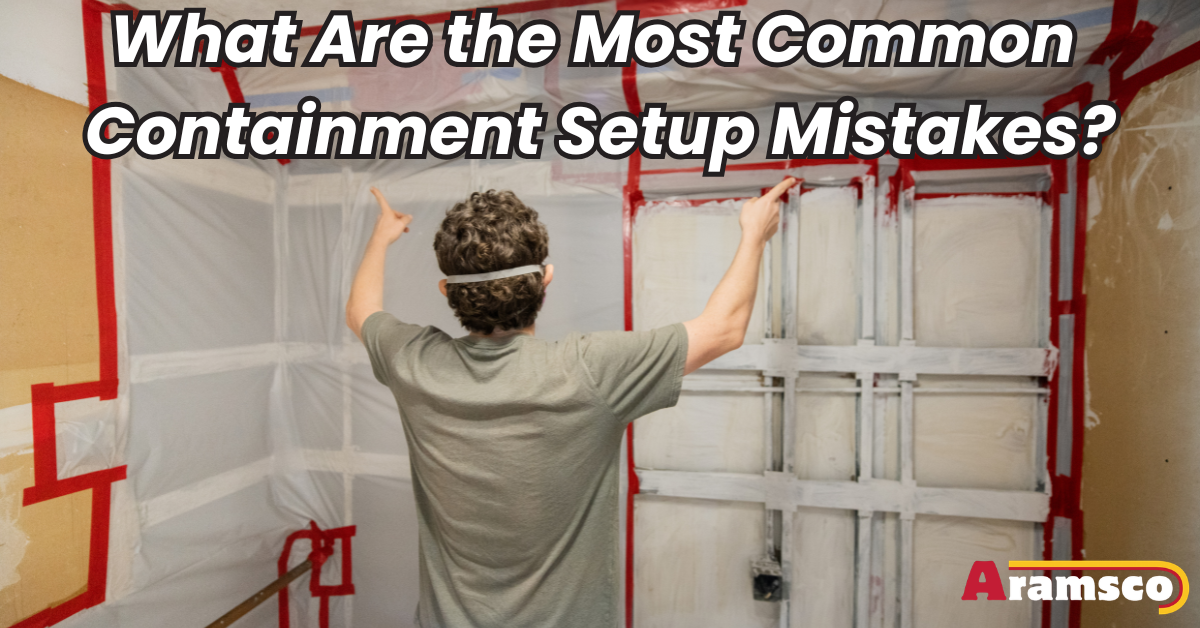
A well-built containment area helps keep dust, debris, and contaminants from spreading beyond the work zone. But even a small setup mistake can create extra cleanup, expose unaffected areas, or slow down the entire project.
Whether you are working on mold remediation, water damage, or another dust-producing job, watch out for these five common containment mistakes.
## 1. Building the Containment Too Small
It may be tempting to isolate only the visibly affected area, but crews also need enough room to work, move equipment, bag debris, and remove materials safely.
A containment that is too tight can make it difficult to avoid bumping walls, damaging plastic sheeting, or carrying contaminated materials against clean surfaces.
Before construction begins, consider:
- The full extent of the affected area
- The tools and equipment needed
- How debris will be removed
- Where workers will enter and exit
- Whether additional damage may be uncovered
The size and complexity of the affected area should help determine the appropriate level of containment. EPA guidance generally distinguishes between limited and full containment based on the size of the contaminated area and the potential for contaminants to spread during remediation.
## 2. Failing to Seal Every Opening
A containment wall may look secure, but contaminants can still escape through small openings.
Commonly missed areas include:
- HVAC supply and return vents
- Electrical outlets
- Gaps around pipes
- Ceiling penetrations
- Door frames
- Floor and wall transitions
Before work starts, inspect the entire perimeter. Secure plastic sheeting properly and confirm that all openings leading outside the work zone have been addressed.
The purpose of containment is to limit the release of mold, dust, and debris into surrounding areas and reduce exposure for workers and building occupants.
## 3. Ignoring the HVAC System
Leaving an HVAC system operating without evaluating it can allow airborne particles to travel throughout the building.
Supply and return vents within the containment may need to be sealed, and the system serving the affected area may need to be shut down depending on the project. However, turning off the wrong equipment can also affect pressure, temperature, humidity, or occupied areas.
Review the HVAC layout before beginning work and follow the project protocol, applicable standards, and site-specific requirements.
## 4. Setting Up Negative Air Incorrectly
Simply placing a negative air machine inside the containment does not guarantee that the setup is working properly.
Common problems include:
- Using equipment that is too small for the space
- Placing the machine where airflow is restricted
- Running ducting incorrectly
- Allowing exhaust air to return to the building
- Using dirty or improperly installed filters
- Failing to check the pressure differential
The system should pull air from cleaner areas toward the work zone and prevent contaminated air from escaping. Pressure and airflow should be checked throughout the project—not only when the equipment is first turned on.
Designing containment and controlling pressure differentials are recognized skills within professional mold remediation work.
## 5. Forgetting About Entry, Exit, and Debris Removal
The containment may perform well while work is happening, but contamination can still spread when workers leave or debris is removed.
Consider where workers will remove personal protective equipment, how tools will be cleaned, and how contaminated materials will be bagged or wrapped.
Avoid dragging unsealed debris through clean or occupied areas. A controlled entry and exit point—or an airlock when required—can help keep contaminants inside the work zone.
OSHA guidance recommends securing plastic over surfaces that could become contaminated and planning the work to contain dust and debris.
Continue checking the setup throughout the project. Plastic can loosen, equipment can shift, filters can load up, and changing job conditions may require the containment to be adjusted.
A little extra time spent inspecting the work zone can prevent contaminants from spreading, reduce unnecessary cleanup, and help the project run more smoothly.
*Visit our [website](http://aramsco.com) to learn more about everything Aramsco offers.*
[Aramsco Restore](https://blog.aramsco.com/tag/aramsco-restore)
- [Tweet](https://twitter.com/share)
[**BLOG HOME**](https://blog.aramsco.com/)
**Where the professionals go to learn about:**
- lead and asbestos abatement
- professional cleaning
- mold, fire, and water restoration
- concrete surface preparation
- business management
### Subscribe to Blog
Search Search Google
### Recent Posts
### Posts by Topic
- [Business (41)](https://blog.aramsco.com/tag/business)
- [Aramsco Clean (36)](https://blog.aramsco.com/tag/aramsco-clean)
- [Aramsco Restore (28)](https://blog.aramsco.com/tag/aramsco-restore)
- [carpet cleaning (27)](https://blog.aramsco.com/tag/carpet-cleaning)
- [Chemistry (19)](https://blog.aramsco.com/tag/chemistry)
- [Rugs (14)](https://blog.aramsco.com/tag/rugs)
- [Carpet (12)](https://blog.aramsco.com/tag/carpet)
- [Aramsco Surface (11)](https://blog.aramsco.com/tag/aramsco-surface)
- [target marketing (11)](https://blog.aramsco.com/tag/target-marketing)
- [Concrete (10)](https://blog.aramsco.com/tag/concrete)
- [Education (9)](https://blog.aramsco.com/tag/education)
- [deodorization (9)](https://blog.aramsco.com/tag/deodorization)
- [special agents (9)](https://blog.aramsco.com/tag/special-agents)
- [upholstery cleaning (9)](https://blog.aramsco.com/tag/upholstery-cleaning)
- [Carpet Presprays (8)](https://blog.aramsco.com/tag/carpet-presprays)
- [Tile & Grout (8)](https://blog.aramsco.com/tag/tile-grout)
- [customer service (8)](https://blog.aramsco.com/tag/customer-service)
- [encapsulation (8)](https://blog.aramsco.com/tag/encapsulation)
- [COVID-19 (7)](https://blog.aramsco.com/tag/covid-19)
- [Spotting (7)](https://blog.aramsco.com/tag/spotting)
- [Stain Removal (7)](https://blog.aramsco.com/tag/stain-removal)
- [Surface Preparation (6)](https://blog.aramsco.com/tag/surface-preparation)
- [Business Finance (5)](https://blog.aramsco.com/tag/business-finance)
- [Customer communication and storytelling (5)](https://blog.aramsco.com/tag/customer-communication-and-storytelling)
- [Grow your business (5)](https://blog.aramsco.com/tag/grow-your-business)
- [carpet protector (5)](https://blog.aramsco.com/tag/carpet-protector)
- [Equipment (4)](https://blog.aramsco.com/tag/equipment)
- [Flooring (3)](https://blog.aramsco.com/tag/flooring)
- [concrete surface preparation (3)](https://blog.aramsco.com/tag/concrete-surface-preparation)
- [sales (3)](https://blog.aramsco.com/tag/sales)
- [IICRC Classes (2)](https://blog.aramsco.com/tag/iicrc-classes)
- [Restoration (2)](https://blog.aramsco.com/tag/restoration)
- [Targeted Marketing (2)](https://blog.aramsco.com/tag/targeted-marketing)
- [Trauma Cleaning (2)](https://blog.aramsco.com/tag/trauma-cleaning)
- [Truckmount (2)](https://blog.aramsco.com/tag/truckmount)
- [carpet coloring (2)](https://blog.aramsco.com/tag/carpet-coloring)
- [Aramsco Service (1)](https://blog.aramsco.com/tag/aramsco-service)
- [Customer Acquisition (1)](https://blog.aramsco.com/tag/customer-acquisition)
- [fiber identification (1)](https://blog.aramsco.com/tag/fiber-identification)
- [news releases (1)](https://blog.aramsco.com/tag/news-releases)
- [portables (1)](https://blog.aramsco.com/tag/portables)
See all
### Blog Archive
- [Tom Forsythe (130)](https://blog.aramsco.com/author/tom-forsythe)
- [Drew Crawford (50)](https://blog.aramsco.com/author/drew-crawford)
- [Aramsco Technical Staff (28)](https://blog.aramsco.com/author/aramsco-technical-staff)
- [Scott Warrington (18)](https://blog.aramsco.com/author/scott-warrington)
- [Jared Twitchell (15)](https://blog.aramsco.com/author/jared-twitchell)
- [Alex Morrill (12)](https://blog.aramsco.com/author/alex-morrill)
- [Steve Johnson (7)](https://blog.aramsco.com/author/steve-johnson)
- [Angela Buckendorf (5)](https://blog.aramsco.com/author/angela-buckendorf)
- [Rachel Adams (4)](https://blog.aramsco.com/author/rachel-adams)
- [Ron Colling (3)](https://blog.aramsco.com/author/ron-colling)
- [Seth Gifford (2)](https://blog.aramsco.com/author/seth-gifford)
- [Nancy Macdonald (2)](https://blog.aramsco.com/author/nancy-macdonald)
- [Gregg Sargent (2)](https://blog.aramsco.com/author/gregg-sargent)
- [Angela Buckendorf & Drew Crawford (1)](https://blog.aramsco.com/author/angela-buckendorf-drew-crawford)
- [Savaana Sihapanya (1)](https://blog.aramsco.com/author/savaana-sihapanya)
- [Dane Gregory (1)](https://blog.aramsco.com/author/dane-gregory)
- [Sandra Hummel (1)](https://blog.aramsco.com/author/sandra-hummel)
- [Luke Draeger (1)](https://blog.aramsco.com/author/luke-draeger)
- [Doyle Bloss (1)](https://blog.aramsco.com/author/doyle-bloss)
- [Tim Schaelling (1)](https://blog.aramsco.com/author/tim-schaelling)
- [Lucas Whitmer (1)](https://blog.aramsco.com/author/lucas-whitmer)
- [Schyler Lewis (1)](https://blog.aramsco.com/author/schyler-lewis)
- [Drew Crawford & Alex Morrill (1)](https://blog.aramsco.com/author/drew-crawford-alex-morrill)
- [Michelle Smith (1)](https://blog.aramsco.com/author/michelle-smith)
See all
#### Current Promotions
Great deals on abatement, safety, surface preparation, and carpet cleaning equipment and chemicals!
[Click to Save](https://aramsco.com/on-sale.html)
#### Online Catalog
All the restoration, safety, cleaning and surface preparation products you need in glossy, digital print.
[See Products](https://cx.aramsco.com/?__hstc=88961988.ca7266f9997610aee14ebd89f4f37653.1557724048361.1557724048361.1557730574295.2&__hssc=88961988.1.1557730574295&__hsfp=35742670)
#### Nexus Conference
Updates on the industry's top conference. Demos, Education, Networking,
and Fun!
[Learn More](https://nexus.aramsco.com/?__hstc=88961988.ca7266f9997610aee14ebd89f4f37653.1557724048361.1557724048361.1557730574295.2&__hssc=88961988.1.1557730574295&__hsfp=35742670)
- Shop By Categories
- [Air Scrubbers](https://www.aramsco.com/equipment-instruments/negative-air-air-scrubbers.html)
- [Carpet Cleaning Chemicals](https://www.aramsco.com/chemicals/cleaning.html)
- [Cleaning Equipment](https://www.aramsco.com/equipment-instruments/cleaning-equipment.html)
- [Cleaning Tools](https://www.aramsco.com/tools-supplies/cleaning-tools-supplies.html)
- [Concrete Grinding](https://aramsco.com/equipment-instruments/grinders-polishers.html)
- [Disinfectants & Antimicrobials](https://www.aramsco.com/chemicals/disinfectants-antimicrobials.html)
- [Drying Equipment](https://www.aramsco.com/equipment-instruments/drying.html)
- [Floor Scrapers](https://www.aramsco.com/equipment-instruments/scrapers.html)
- [Mastic Removers](https://www.aramsco.com/chemicals/adhesive-coating-removers.html)
- [Odor Neutralizers](https://www.aramsco.com/chemicals/odor-control.html)
- [Poly Sheeting](https://www.aramsco.com/plastics-adhesives/poly-sheeting.html)
- [Respirators](https://www.aramsco.com/safety-ppe/respirators-respiratory-protection.html)
- [Shot Blasting](https://www.aramsco.com/equipment-instruments/shot-abrasive-blasting.html)
- [Thermal Imaging](https://www.aramsco.com/equipment-instruments/meters-testing/infrared-temperature.html)
- [Vacuums](https://www.aramsco.com/equipment-instruments/vacuums.html)
- Resources
- [Pro's Corner](https://blog.aramsco.com)
- [Classifieds](https://classifieds.aramsco.com/)
- [Monthly Ad](https://cx.aramsco.com/)
- [Education Schedule](https://www.cvent.com/c/calendar/ab53c6cb-fee0-44a6-a384-c51a2a4b32c0)
- [Equipment Financing](https://aztecfinancial.com/)
- [Equipment Rental](https://www.aramsco.com/training-rentals-repairs)
- [Equipment Repair](https://www.aramsco.com/training-rentals-repairs)
- [Site Map](https://www.aramsco.com/training-rentals-repairs)
- Company Info
- [About Us](https://www.aramsco.com/aboutus)
- [Careers](https://workforcenow.adp.com/jobs/apply/posting.html?client=aramsco&ccId=19000101_000001&type=MP&lang=en_US)
- [Contact Us](https://www.aramsco.com/contact)
- [News](https://www.aramsco.com/news)
- OUR BRANDS
- [Aztec Financial](https://aztecfinancial.com/)
- [NSS](https://nssusa.com/)
- [Safety Express](http://safetyexpress.com/?__hstc=88961988.ca7266f9997610aee14ebd89f4f37653.1557724048361.1557724048361.1557730574295.2&__hssc=88961988.2.1557730574295&__hsfp=35742670)
- Policies
- [Privacy Policy](https://www.aramsco.com/privacy-policy)
- [Return Policy](https://www.aramsco.com/terms-conditions#returns)
- [Shipping Policy](https://www.aramsco.com/terms-conditions#shipping)
- [Terms & Conditions](https://www.aramsco.com/terms-conditions)
- Corporate Location
- Find a location Near You
- [Location image](https://www.aramsco.com/locations)
Corporate Location
- Aramsco, Inc.
Five Radnor Corporate Center
100 Matsonford Road Suite 510
Radnor, PA 19087
- (800) 767-6933
- customer.service@aramsco.com
Copyright © 2025 Aramsco. All rights reserved.
```json
{
"@context" : "https://schema.org",
"@type" : "BlogPosting",
"author" : {
"@type" : "Person",
"name" : "Aramsco Technical Staff",
"url" : "https://blog.aramsco.com/author/aramsco-technical-staff"
},
"dateModified" : "2026-07-21T19:39:32.919Z",
"datePublished" : "2026-07-21T19:39:32.000Z",
"headline" : "What Are the Most Common Containment Setup Mistakes?",
"image" : [ "https://blog.aramsco.com/hubfs/containment%20blog.png" ],
"mainEntityOfPage" : {
"@id" : "https://blog.aramsco.com/what-are-the-most-common-containment-setup-mistakes",
"@type" : "WebPage"
},
"publisher" : {
"@type" : "Organization",
"logo" : {
"@type" : "ImageObject",
"url" : "https://blog.aramsco.com/hubfs/Logos/Aramsco%20R%20Family%20-%20Equipped%20for%20Success.png"
},
"name" : "Aramsco"
}
}
```