---
title: How To Get The Most Out Of Your Reciprocating Blades
description: Learn how to maximize performance with reciprocating saw blades. Discover tips for plunge cutting, choosing the right blade, and improving efficiency on the job site.
image: https://blog.aramsco.com/hubfs/Copy%20of%20Copy%20of%20water%20quality.png
---
- [Home](https://aramsco.com)
- [Pro's Corner](https://blog.aramsco.com)
[](https://www.aramsco.com/)
- [Home](https://aramsco.com)
- [Pro's Corner](https://blog.aramsco.com)
- Account
- [locations](http://aramsco-live.epicorcommerce.com/locations/)
- [education](http://aramsco-live.epicorcommerce.com/education/)
- [about us](http://aramsco-live.epicorcommerce.com/aboutus/)
# Pro's Corner
## [How To Get The Most Out Of Your Reciprocating Blades](https://blog.aramsco.com/how-to-get-the-most-out-of-your-reciprocating-blades)
Posted by Lucas Whitmer on Mar 31st 2026

**Get the Most Out of Your Reciprocating Saw Blades**
*The following blog was submitted by Lucas Whitmer, Product Development Engineer for The M. K. Morse Company *
"On the job site, you need a lineup of reciprocating blades to tackle any challenge in your way.
Reciprocating saw blades from The M. K. Morse Company are specifically designed for the applications they are meant to cut and deliver fast and quality results with long blade life.
Read on for some tech tips from our master cutters to ensure you get the most out of your reciprocating blades in every scenario.
**Plunge cutting done right**
**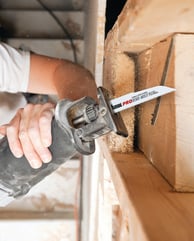**Plunge cutting can deliver clean, accurate, and perfectly straight cuts — even when you start right in the middle of your workpiece. Mastering this essential technique will help you cut faster, work smarter, and achieve flawless results every time**.**
The [PRO Demo-Wood](https://www.aramsco.com/m-k-morse-saw-blade-reciprocating-heat-resistant-6t-9-x-3-4-x-0-035.html) blade is designed for perfect plunge cuts every time. By loading the blade upside down in your reciprocating saw, you can ensure the battery pack stays out the way, allowing for quicker and more accurate cutting. But safety first – be sure to remove your saw battery before changing the orientation of the blade.
Come in square to the workpiece and apply strong pressure to ensure the blade and saw don’t bounce away from the workpiece. Depending on the position and orientation of your application, it may make sense to use your non-dominant hand closer to the blade to get appropriate pressure for the best cutting results.
**Tackle general purpose, demo cutting with one blade**
When jumping from material to material at a demolition or job site, don’t get slowed down by also jumping from blade to blade. The [PRO Demo-Multi](https://www.aramsco.com/m-k-morse-saw-blades-for-wood-and-metal-8-x-3-4-x-0-035.html) reciprocating blade is designed for versatility – a 7/8” blade body has the beam strength to tackle a variety of applications. Its 1/16” (.062”) thickness prevents the blade from flapping during a cut, which can impact safety and blade life.
When using the 8/11 TPI, it features a variable pitch, so you get less noise and vibration when working through nail-embedded wood. This means after hours on the job, you aren’t feeling the same fatigue you may when working with competitive blades.
The stiff and durable blade body and variable pitch teeth give you what you need – control in the cut and guaranteed results every time.
**Pick the right blade for the job**
Ensuring the best end result starts with choosing the proper reciprocating saw blade from the start. At Morse, they make it easy to find the best blade for your cutting scenario. With options for wood, thin and thick metal, demolition, general purpose, automotive & fire rescue, pallet, plaster, and grit, they have a solution no matter what you are facing.
We always recommend first identifying what you will primarily be cutting. This allows you to choose the proper application blade in the right length. The rule of thumb is to use a blade 2” longer than the application you are cutting in the direction you will be executing the cut. For example, a 2” x 2” construction tube would be easily handled with our **PRO-CT Thick Metal** 6” blade; while a 9” x 2” steel stud could be cut using the [**HD Thin Metal**](https://www.aramsco.com/catalogsearch/result/?q=HD+Thin+Metal+morse) 12”, if cutting the piece lengthwise. This is important, especially in structural applications, because you don’t want the nose of the blade to get hung up in the front of the cut and bend into the shape of a question mark (potentially injuring your wrists, ruining the blade, and damaging your workpiece).
Blade thickness is also important for performance. For demolition-style work, we recommend a slightly thicker blade, like the **PRO Demo-Multi** (.062”)or**[HD Wood](https://www.aramsco.com/catalogsearch/result/?q=+HD+Wood+morse)**(.050”) blades. For easier-to-cut materials, flush cutting, or cutting scenarios where you need to get in between two pieces and require a more flexible blade, we recommend something thinner, like the **[HD Thin Metal](https://www.aramsco.com/catalogsearch/result/?q=HD+Thin+Metal+morse) (.035”)** blade. **PRO Thin**, **Medium** and [**Thick Metal**](https://www.aramsco.com/catalogsearch/result/?q=Thick+Metal+morse) cutting blades (.042”) are great for general metal cutting, structural applications, and solids.
Next, consider blade width. Very hearty materials or demolition applications like nail-embedded wood need a 7/8” or wider blade; something with a bit more beam strength to handle heavier pressure. When tackling easier-to-cut materials like Unistrut or steel studs, a slightly shorter blade may be favorable, like a 3/4” blade.
Lastly, choose the correct TPI (tooth per inch) to suit your application. Thicker materials require a coarser TPI, while thinner materials need a finer TPI. If performing exhaust work and cutting tubing 1/8” thick, an 18 TPI is perfect for that material. If cutting something thick like ¼” wall tube, we’d recommend an 8 or 10 TPI. Demolition work is optimized for a 6 TPI, but if there are nails and screws in the workpiece, use an 8/11 TPI to maximize performance.
Tackle any material with speed and get the best cutting results by using a solution from the Morse lineup of reciprocating saw blades."
Checkout all the MK Morse Reciprocating blades Aramsco offers [here](https://www.aramsco.com/brand/m-k-morse)!
[Aramsco Restore](https://blog.aramsco.com/tag/aramsco-restore)
- [Tweet](https://twitter.com/share)
[**BLOG HOME**](https://blog.aramsco.com/)
**Where the professionals go to learn about:**
- lead and asbestos abatement
- professional cleaning
- mold, fire, and water restoration
- concrete surface preparation
- business management
### Subscribe to Blog
Search Search Google
### Recent Posts
### Posts by Topic
- [Business (41)](https://blog.aramsco.com/tag/business)
- [Aramsco Clean (35)](https://blog.aramsco.com/tag/aramsco-clean)
- [Aramsco Restore (28)](https://blog.aramsco.com/tag/aramsco-restore)
- [carpet cleaning (27)](https://blog.aramsco.com/tag/carpet-cleaning)
- [Chemistry (19)](https://blog.aramsco.com/tag/chemistry)
- [Rugs (14)](https://blog.aramsco.com/tag/rugs)
- [Carpet (12)](https://blog.aramsco.com/tag/carpet)
- [Aramsco Surface (11)](https://blog.aramsco.com/tag/aramsco-surface)
- [target marketing (11)](https://blog.aramsco.com/tag/target-marketing)
- [Concrete (10)](https://blog.aramsco.com/tag/concrete)
- [Education (9)](https://blog.aramsco.com/tag/education)
- [deodorization (9)](https://blog.aramsco.com/tag/deodorization)
- [special agents (9)](https://blog.aramsco.com/tag/special-agents)
- [upholstery cleaning (9)](https://blog.aramsco.com/tag/upholstery-cleaning)
- [Carpet Presprays (8)](https://blog.aramsco.com/tag/carpet-presprays)
- [Tile & Grout (8)](https://blog.aramsco.com/tag/tile-grout)
- [customer service (8)](https://blog.aramsco.com/tag/customer-service)
- [encapsulation (8)](https://blog.aramsco.com/tag/encapsulation)
- [COVID-19 (7)](https://blog.aramsco.com/tag/covid-19)
- [Spotting (7)](https://blog.aramsco.com/tag/spotting)
- [Stain Removal (7)](https://blog.aramsco.com/tag/stain-removal)
- [Surface Preparation (6)](https://blog.aramsco.com/tag/surface-preparation)
- [Business Finance (5)](https://blog.aramsco.com/tag/business-finance)
- [Customer communication and storytelling (5)](https://blog.aramsco.com/tag/customer-communication-and-storytelling)
- [Grow your business (5)](https://blog.aramsco.com/tag/grow-your-business)
- [carpet protector (5)](https://blog.aramsco.com/tag/carpet-protector)
- [Equipment (4)](https://blog.aramsco.com/tag/equipment)
- [Flooring (3)](https://blog.aramsco.com/tag/flooring)
- [concrete surface preparation (3)](https://blog.aramsco.com/tag/concrete-surface-preparation)
- [sales (3)](https://blog.aramsco.com/tag/sales)
- [IICRC Classes (2)](https://blog.aramsco.com/tag/iicrc-classes)
- [Restoration (2)](https://blog.aramsco.com/tag/restoration)
- [Targeted Marketing (2)](https://blog.aramsco.com/tag/targeted-marketing)
- [Trauma Cleaning (2)](https://blog.aramsco.com/tag/trauma-cleaning)
- [Truckmount (2)](https://blog.aramsco.com/tag/truckmount)
- [carpet coloring (2)](https://blog.aramsco.com/tag/carpet-coloring)
- [Aramsco Service (1)](https://blog.aramsco.com/tag/aramsco-service)
- [Customer Acquisition (1)](https://blog.aramsco.com/tag/customer-acquisition)
- [fiber identification (1)](https://blog.aramsco.com/tag/fiber-identification)
- [news releases (1)](https://blog.aramsco.com/tag/news-releases)
- [portables (1)](https://blog.aramsco.com/tag/portables)
See all
### Blog Archive
- [Tom Forsythe (130)](https://blog.aramsco.com/author/tom-forsythe)
- [Drew Crawford (50)](https://blog.aramsco.com/author/drew-crawford)
- [Aramsco Technical Staff (26)](https://blog.aramsco.com/author/aramsco-technical-staff)
- [Scott Warrington (18)](https://blog.aramsco.com/author/scott-warrington)
- [Jared Twitchell (15)](https://blog.aramsco.com/author/jared-twitchell)
- [Alex Morrill (12)](https://blog.aramsco.com/author/alex-morrill)
- [Steve Johnson (7)](https://blog.aramsco.com/author/steve-johnson)
- [Angela Buckendorf (5)](https://blog.aramsco.com/author/angela-buckendorf)
- [Rachel Adams (4)](https://blog.aramsco.com/author/rachel-adams)
- [Ron Colling (3)](https://blog.aramsco.com/author/ron-colling)
- [Seth Gifford (2)](https://blog.aramsco.com/author/seth-gifford)
- [Nancy Macdonald (2)](https://blog.aramsco.com/author/nancy-macdonald)
- [Gregg Sargent (2)](https://blog.aramsco.com/author/gregg-sargent)
- [Angela Buckendorf & Drew Crawford (1)](https://blog.aramsco.com/author/angela-buckendorf-drew-crawford)
- [Savaana Sihapanya (1)](https://blog.aramsco.com/author/savaana-sihapanya)
- [Dane Gregory (1)](https://blog.aramsco.com/author/dane-gregory)
- [Sandra Hummel (1)](https://blog.aramsco.com/author/sandra-hummel)
- [Luke Draeger (1)](https://blog.aramsco.com/author/luke-draeger)
- [Doyle Bloss (1)](https://blog.aramsco.com/author/doyle-bloss)
- [Tim Schaelling (1)](https://blog.aramsco.com/author/tim-schaelling)
- [Lucas Whitmer (1)](https://blog.aramsco.com/author/lucas-whitmer)
- [Schyler Lewis (1)](https://blog.aramsco.com/author/schyler-lewis)
- [Drew Crawford & Alex Morrill (1)](https://blog.aramsco.com/author/drew-crawford-alex-morrill)
- [Michelle Smith (1)](https://blog.aramsco.com/author/michelle-smith)
See all
#### Current Promotions
Great deals on abatement, safety, surface preparation, and carpet cleaning equipment and chemicals!
[Click to Save](https://aramsco.com/on-sale.html)
#### Online Catalog
All the restoration, safety, cleaning and surface preparation products you need in glossy, digital print.
[See Products](https://cx.aramsco.com/?__hstc=88961988.ca7266f9997610aee14ebd89f4f37653.1557724048361.1557724048361.1557730574295.2&__hssc=88961988.1.1557730574295&__hsfp=35742670)
#### Nexus Conference
Updates on the industry's top conference. Demos, Education, Networking,
and Fun!
[Learn More](https://nexus.aramsco.com/?__hstc=88961988.ca7266f9997610aee14ebd89f4f37653.1557724048361.1557724048361.1557730574295.2&__hssc=88961988.1.1557730574295&__hsfp=35742670)
- Shop By Categories
- [Air Scrubbers](https://www.aramsco.com/equipment-instruments/negative-air-air-scrubbers.html)
- [Carpet Cleaning Chemicals](https://www.aramsco.com/chemicals/cleaning.html)
- [Cleaning Equipment](https://www.aramsco.com/equipment-instruments/cleaning-equipment.html)
- [Cleaning Tools](https://www.aramsco.com/tools-supplies/cleaning-tools-supplies.html)
- [Concrete Grinding](https://aramsco.com/equipment-instruments/grinders-polishers.html)
- [Disinfectants & Antimicrobials](https://www.aramsco.com/chemicals/disinfectants-antimicrobials.html)
- [Drying Equipment](https://www.aramsco.com/equipment-instruments/drying.html)
- [Floor Scrapers](https://www.aramsco.com/equipment-instruments/scrapers.html)
- [Mastic Removers](https://www.aramsco.com/chemicals/adhesive-coating-removers.html)
- [Odor Neutralizers](https://www.aramsco.com/chemicals/odor-control.html)
- [Poly Sheeting](https://www.aramsco.com/plastics-adhesives/poly-sheeting.html)
- [Respirators](https://www.aramsco.com/safety-ppe/respirators-respiratory-protection.html)
- [Shot Blasting](https://www.aramsco.com/equipment-instruments/shot-abrasive-blasting.html)
- [Thermal Imaging](https://www.aramsco.com/equipment-instruments/meters-testing/infrared-temperature.html)
- [Vacuums](https://www.aramsco.com/equipment-instruments/vacuums.html)
- Resources
- [Pro's Corner](https://blog.aramsco.com)
- [Classifieds](https://classifieds.aramsco.com/)
- [Monthly Ad](https://cx.aramsco.com/)
- [Education Schedule](https://www.cvent.com/c/calendar/ab53c6cb-fee0-44a6-a384-c51a2a4b32c0)
- [Equipment Financing](https://aztecfinancial.com/)
- [Equipment Rental](https://www.aramsco.com/training-rentals-repairs)
- [Equipment Repair](https://www.aramsco.com/training-rentals-repairs)
- [Site Map](https://www.aramsco.com/training-rentals-repairs)
- Company Info
- [About Us](https://www.aramsco.com/aboutus)
- [Careers](https://workforcenow.adp.com/jobs/apply/posting.html?client=aramsco&ccId=19000101_000001&type=MP&lang=en_US)
- [Contact Us](https://www.aramsco.com/contact)
- [News](https://www.aramsco.com/news)
- OUR BRANDS
- [Aztec Financial](https://aztecfinancial.com/)
- [NSS](https://nssusa.com/)
- [Safety Express](http://safetyexpress.com/?__hstc=88961988.ca7266f9997610aee14ebd89f4f37653.1557724048361.1557724048361.1557730574295.2&__hssc=88961988.2.1557730574295&__hsfp=35742670)
- Policies
- [Privacy Policy](https://www.aramsco.com/privacy-policy)
- [Return Policy](https://www.aramsco.com/terms-conditions#returns)
- [Shipping Policy](https://www.aramsco.com/terms-conditions#shipping)
- [Terms & Conditions](https://www.aramsco.com/terms-conditions)
- Corporate Location
- Find a location Near You
- [Location image](https://www.aramsco.com/locations)
Corporate Location
- Aramsco, Inc.
Five Radnor Corporate Center
100 Matsonford Road Suite 510
Radnor, PA 19087
- (800) 767-6933
- customer.service@aramsco.com
Copyright © 2025 Aramsco. All rights reserved.
```json
{
"@context" : "https://schema.org",
"@type" : "BlogPosting",
"author" : {
"@type" : "Person",
"name" : "Lucas Whitmer",
"url" : "https://blog.aramsco.com/author/lucas-whitmer"
},
"dateModified" : "2026-03-31T19:14:59.048Z",
"datePublished" : "2026-03-31T19:14:59.000Z",
"headline" : "How To Get The Most Out Of Your Reciprocating Blades",
"image" : [ "https://blog.aramsco.com/hubfs/Copy%20of%20Copy%20of%20water%20quality.png" ],
"mainEntityOfPage" : {
"@id" : "https://blog.aramsco.com/how-to-get-the-most-out-of-your-reciprocating-blades",
"@type" : "WebPage"
},
"publisher" : {
"@type" : "Organization",
"logo" : {
"@type" : "ImageObject",
"url" : "https://blog.aramsco.com/hubfs/Logos/Aramsco%20R%20Family%20-%20Equipped%20for%20Success.png"
},
"name" : "Aramsco"
}
}
```