---
title: "Moisture Testing in Concrete: Why It Matters Before Coatings"
description: Before applying epoxy or floor coatings, moisture testing is critical. Learn why concrete moisture testing matters, the best testing methods, and how to prevent costly coating failures.
image: https://blog.aramsco.com/hubfs/Copy%20of%20Copy%20of%20avoid%20costly%20mistakes%20blog.png
---
- [Home](https://aramsco.com)
- [Pro's Corner](https://blog.aramsco.com)
[](https://www.aramsco.com/)
- [Home](https://aramsco.com)
- [Pro's Corner](https://blog.aramsco.com)
- Account
- [locations](http://aramsco-live.epicorcommerce.com/locations/)
- [education](http://aramsco-live.epicorcommerce.com/education/)
- [about us](http://aramsco-live.epicorcommerce.com/aboutus/)
# Pro's Corner
## [Moisture Testing in Concrete: Why It Matters Before Coatings](https://blog.aramsco.com/moisture-testing-in-concrete-why-it-matters-before-coatings)
Posted by Aramsco Technical Staff on Feb 12th 2026
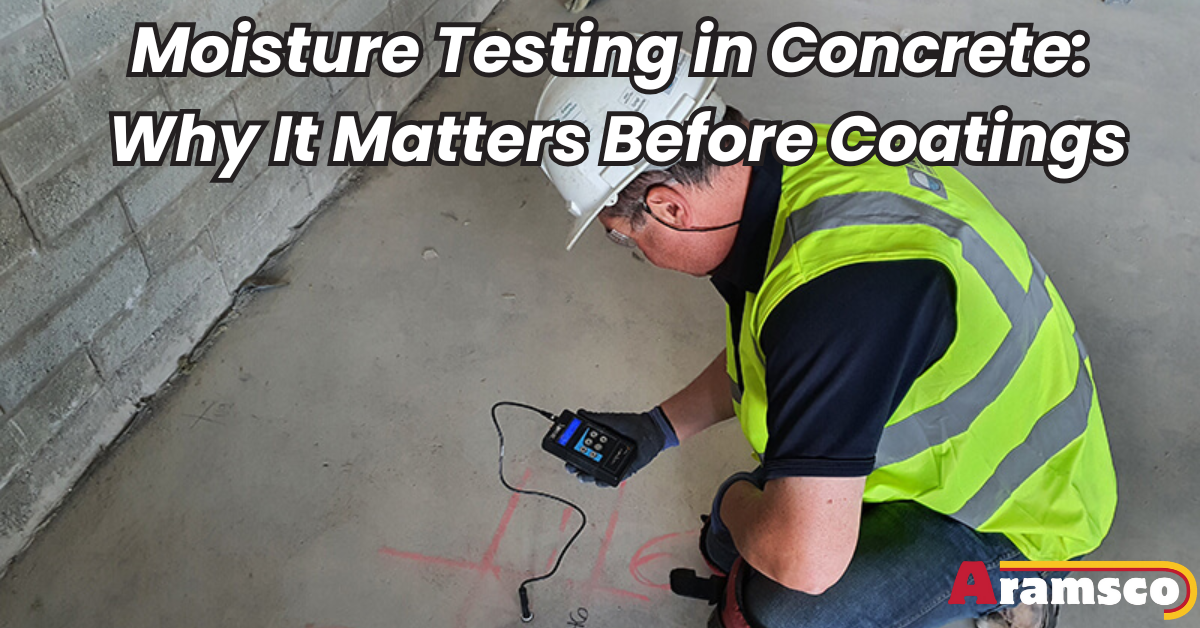
Concrete might look dry on the surface — but what’s happening inside the slab can determine whether your coating succeeds or fails.
Moisture-related failures are one of the most common causes of peeling, blistering, and delamination in epoxy and resinous flooring systems. The culprit? Excess moisture vapor trapped beneath the coating.
Skipping moisture testing can turn a profitable job into an expensive redo.
## 
## Why Moisture Matters
Concrete is porous and continues to transmit moisture vapor long after it cures. When coatings are applied over slabs with high internal moisture:
- Vapor pressure builds
- Adhesion weakens
- Bubbling and blistering occur
- Coatings delaminate
The result: costly removal, re-prep, new materials, and lost time.
## Common Moisture Testing Methods
### In-Situ Relative Humidity (RH) Testing
Measures internal slab moisture (ASTM F2170).
Often preferred by manufacturers because it reflects long-term moisture conditions.
### Calcium Chloride Testing (MVER)
Measures surface vapor emission rate (ASTM F1869).
Useful, but only evaluates the top portion of the slab.
### [Moisture Meters](https://www.aramsco.com/1609-9398-tramex-cme5-concrete-moisture-meter-moisture-content-for-concrete-0-6-penetration-depth-3-4-20mm-199039.html)
Great for quick scanning and identifying trouble areas — but not a replacement for ASTM-compliant testing.
## When Should You Test?
- Before any epoxy or resinous coating application
- On new slabs (even if fully cured)
- After water exposure
- On below-grade or unknown vapor barrier slabs
Even older concrete can retain and transmit moisture.
## Protect Your Warranty — and Your Margins
Most coating manufacturers specify maximum RH or MVER limits. Exceeding those limits can void warranties and lead to failure.
Testing takes a few extra hours. Replacing a failed floor takes days — and thousands of dollars.
Moisture testing isn’t optional — it’s part of professional surface prep.
Know your numbers before you coat. It protects your profit, your reputation, and your customer!
***Have a blog topic you want us to discuss? Leave a comment below!***
[Concrete](https://blog.aramsco.com/tag/concrete)
- [Tweet](https://twitter.com/share)
[**BLOG HOME**](https://blog.aramsco.com/)
**Where the professionals go to learn about:**
- lead and asbestos abatement
- professional cleaning
- mold, fire, and water restoration
- concrete surface preparation
- business management
### Subscribe to Blog
Search Search Google
### Recent Posts
### Posts by Topic
- [Business (41)](https://blog.aramsco.com/tag/business)
- [Aramsco Clean (36)](https://blog.aramsco.com/tag/aramsco-clean)
- [Aramsco Restore (28)](https://blog.aramsco.com/tag/aramsco-restore)
- [carpet cleaning (27)](https://blog.aramsco.com/tag/carpet-cleaning)
- [Chemistry (19)](https://blog.aramsco.com/tag/chemistry)
- [Rugs (14)](https://blog.aramsco.com/tag/rugs)
- [Carpet (12)](https://blog.aramsco.com/tag/carpet)
- [Aramsco Surface (11)](https://blog.aramsco.com/tag/aramsco-surface)
- [target marketing (11)](https://blog.aramsco.com/tag/target-marketing)
- [Concrete (10)](https://blog.aramsco.com/tag/concrete)
- [Education (9)](https://blog.aramsco.com/tag/education)
- [deodorization (9)](https://blog.aramsco.com/tag/deodorization)
- [special agents (9)](https://blog.aramsco.com/tag/special-agents)
- [upholstery cleaning (9)](https://blog.aramsco.com/tag/upholstery-cleaning)
- [Carpet Presprays (8)](https://blog.aramsco.com/tag/carpet-presprays)
- [Tile & Grout (8)](https://blog.aramsco.com/tag/tile-grout)
- [customer service (8)](https://blog.aramsco.com/tag/customer-service)
- [encapsulation (8)](https://blog.aramsco.com/tag/encapsulation)
- [COVID-19 (7)](https://blog.aramsco.com/tag/covid-19)
- [Spotting (7)](https://blog.aramsco.com/tag/spotting)
- [Stain Removal (7)](https://blog.aramsco.com/tag/stain-removal)
- [Surface Preparation (6)](https://blog.aramsco.com/tag/surface-preparation)
- [Business Finance (5)](https://blog.aramsco.com/tag/business-finance)
- [Customer communication and storytelling (5)](https://blog.aramsco.com/tag/customer-communication-and-storytelling)
- [Grow your business (5)](https://blog.aramsco.com/tag/grow-your-business)
- [carpet protector (5)](https://blog.aramsco.com/tag/carpet-protector)
- [Equipment (4)](https://blog.aramsco.com/tag/equipment)
- [Flooring (3)](https://blog.aramsco.com/tag/flooring)
- [concrete surface preparation (3)](https://blog.aramsco.com/tag/concrete-surface-preparation)
- [sales (3)](https://blog.aramsco.com/tag/sales)
- [IICRC Classes (2)](https://blog.aramsco.com/tag/iicrc-classes)
- [Restoration (2)](https://blog.aramsco.com/tag/restoration)
- [Targeted Marketing (2)](https://blog.aramsco.com/tag/targeted-marketing)
- [Trauma Cleaning (2)](https://blog.aramsco.com/tag/trauma-cleaning)
- [Truckmount (2)](https://blog.aramsco.com/tag/truckmount)
- [carpet coloring (2)](https://blog.aramsco.com/tag/carpet-coloring)
- [Aramsco Service (1)](https://blog.aramsco.com/tag/aramsco-service)
- [Customer Acquisition (1)](https://blog.aramsco.com/tag/customer-acquisition)
- [fiber identification (1)](https://blog.aramsco.com/tag/fiber-identification)
- [news releases (1)](https://blog.aramsco.com/tag/news-releases)
- [portables (1)](https://blog.aramsco.com/tag/portables)
See all
### Blog Archive
- [Tom Forsythe (130)](https://blog.aramsco.com/author/tom-forsythe)
- [Drew Crawford (50)](https://blog.aramsco.com/author/drew-crawford)
- [Aramsco Technical Staff (27)](https://blog.aramsco.com/author/aramsco-technical-staff)
- [Scott Warrington (18)](https://blog.aramsco.com/author/scott-warrington)
- [Jared Twitchell (15)](https://blog.aramsco.com/author/jared-twitchell)
- [Alex Morrill (12)](https://blog.aramsco.com/author/alex-morrill)
- [Steve Johnson (7)](https://blog.aramsco.com/author/steve-johnson)
- [Angela Buckendorf (5)](https://blog.aramsco.com/author/angela-buckendorf)
- [Rachel Adams (4)](https://blog.aramsco.com/author/rachel-adams)
- [Ron Colling (3)](https://blog.aramsco.com/author/ron-colling)
- [Seth Gifford (2)](https://blog.aramsco.com/author/seth-gifford)
- [Nancy Macdonald (2)](https://blog.aramsco.com/author/nancy-macdonald)
- [Gregg Sargent (2)](https://blog.aramsco.com/author/gregg-sargent)
- [Angela Buckendorf & Drew Crawford (1)](https://blog.aramsco.com/author/angela-buckendorf-drew-crawford)
- [Savaana Sihapanya (1)](https://blog.aramsco.com/author/savaana-sihapanya)
- [Dane Gregory (1)](https://blog.aramsco.com/author/dane-gregory)
- [Sandra Hummel (1)](https://blog.aramsco.com/author/sandra-hummel)
- [Luke Draeger (1)](https://blog.aramsco.com/author/luke-draeger)
- [Doyle Bloss (1)](https://blog.aramsco.com/author/doyle-bloss)
- [Tim Schaelling (1)](https://blog.aramsco.com/author/tim-schaelling)
- [Lucas Whitmer (1)](https://blog.aramsco.com/author/lucas-whitmer)
- [Schyler Lewis (1)](https://blog.aramsco.com/author/schyler-lewis)
- [Drew Crawford & Alex Morrill (1)](https://blog.aramsco.com/author/drew-crawford-alex-morrill)
- [Michelle Smith (1)](https://blog.aramsco.com/author/michelle-smith)
See all
#### Current Promotions
Great deals on abatement, safety, surface preparation, and carpet cleaning equipment and chemicals!
[Click to Save](https://aramsco.com/on-sale.html)
#### Online Catalog
All the restoration, safety, cleaning and surface preparation products you need in glossy, digital print.
[See Products](https://cx.aramsco.com/?__hstc=88961988.ca7266f9997610aee14ebd89f4f37653.1557724048361.1557724048361.1557730574295.2&__hssc=88961988.1.1557730574295&__hsfp=35742670)
#### Nexus Conference
Updates on the industry's top conference. Demos, Education, Networking,
and Fun!
[Learn More](https://nexus.aramsco.com/?__hstc=88961988.ca7266f9997610aee14ebd89f4f37653.1557724048361.1557724048361.1557730574295.2&__hssc=88961988.1.1557730574295&__hsfp=35742670)
- Shop By Categories
- [Air Scrubbers](https://www.aramsco.com/equipment-instruments/negative-air-air-scrubbers.html)
- [Carpet Cleaning Chemicals](https://www.aramsco.com/chemicals/cleaning.html)
- [Cleaning Equipment](https://www.aramsco.com/equipment-instruments/cleaning-equipment.html)
- [Cleaning Tools](https://www.aramsco.com/tools-supplies/cleaning-tools-supplies.html)
- [Concrete Grinding](https://aramsco.com/equipment-instruments/grinders-polishers.html)
- [Disinfectants & Antimicrobials](https://www.aramsco.com/chemicals/disinfectants-antimicrobials.html)
- [Drying Equipment](https://www.aramsco.com/equipment-instruments/drying.html)
- [Floor Scrapers](https://www.aramsco.com/equipment-instruments/scrapers.html)
- [Mastic Removers](https://www.aramsco.com/chemicals/adhesive-coating-removers.html)
- [Odor Neutralizers](https://www.aramsco.com/chemicals/odor-control.html)
- [Poly Sheeting](https://www.aramsco.com/plastics-adhesives/poly-sheeting.html)
- [Respirators](https://www.aramsco.com/safety-ppe/respirators-respiratory-protection.html)
- [Shot Blasting](https://www.aramsco.com/equipment-instruments/shot-abrasive-blasting.html)
- [Thermal Imaging](https://www.aramsco.com/equipment-instruments/meters-testing/infrared-temperature.html)
- [Vacuums](https://www.aramsco.com/equipment-instruments/vacuums.html)
- Resources
- [Pro's Corner](https://blog.aramsco.com)
- [Classifieds](https://classifieds.aramsco.com/)
- [Monthly Ad](https://cx.aramsco.com/)
- [Education Schedule](https://www.cvent.com/c/calendar/ab53c6cb-fee0-44a6-a384-c51a2a4b32c0)
- [Equipment Financing](https://aztecfinancial.com/)
- [Equipment Rental](https://www.aramsco.com/training-rentals-repairs)
- [Equipment Repair](https://www.aramsco.com/training-rentals-repairs)
- [Site Map](https://www.aramsco.com/training-rentals-repairs)
- Company Info
- [About Us](https://www.aramsco.com/aboutus)
- [Careers](https://workforcenow.adp.com/jobs/apply/posting.html?client=aramsco&ccId=19000101_000001&type=MP&lang=en_US)
- [Contact Us](https://www.aramsco.com/contact)
- [News](https://www.aramsco.com/news)
- OUR BRANDS
- [Aztec Financial](https://aztecfinancial.com/)
- [NSS](https://nssusa.com/)
- [Safety Express](http://safetyexpress.com/?__hstc=88961988.ca7266f9997610aee14ebd89f4f37653.1557724048361.1557724048361.1557730574295.2&__hssc=88961988.2.1557730574295&__hsfp=35742670)
- Policies
- [Privacy Policy](https://www.aramsco.com/privacy-policy)
- [Return Policy](https://www.aramsco.com/terms-conditions#returns)
- [Shipping Policy](https://www.aramsco.com/terms-conditions#shipping)
- [Terms & Conditions](https://www.aramsco.com/terms-conditions)
- Corporate Location
- Find a location Near You
- [Location image](https://www.aramsco.com/locations)
Corporate Location
- Aramsco, Inc.
Five Radnor Corporate Center
100 Matsonford Road Suite 510
Radnor, PA 19087
- (800) 767-6933
- customer.service@aramsco.com
Copyright © 2025 Aramsco. All rights reserved.
```json
{
"@context" : "https://schema.org",
"@type" : "BlogPosting",
"author" : {
"@type" : "Person",
"name" : "Aramsco Technical Staff",
"url" : "https://blog.aramsco.com/author/aramsco-technical-staff"
},
"dateModified" : "2026-02-12T20:54:47.743Z",
"datePublished" : "2026-02-12T20:54:47.000Z",
"headline" : "Moisture Testing in Concrete: Why It Matters Before Coatings",
"image" : [ "https://blog.aramsco.com/hubfs/Copy%20of%20Copy%20of%20avoid%20costly%20mistakes%20blog.png" ],
"mainEntityOfPage" : {
"@id" : "https://blog.aramsco.com/moisture-testing-in-concrete-why-it-matters-before-coatings",
"@type" : "WebPage"
},
"publisher" : {
"@type" : "Organization",
"logo" : {
"@type" : "ImageObject",
"url" : "https://blog.aramsco.com/hubfs/Logos/Aramsco%20R%20Family%20-%20Equipped%20for%20Success.png"
},
"name" : "Aramsco"
}
}
```