---
title: Ultimate Guide to Restoring Extremely Dirty Carpets!
description: Learn how to clean severely dirty carpets with a step-by-step process, from dry soil removal to deep cleaning, rinsing, and proper drying.
image: https://blog.aramsco.com/hubfs/Copy%20of%20Copy%20of%20blog.png
---
- [Home](https://aramsco.com)
- [Pro's Corner](https://blog.aramsco.com)
[](https://www.aramsco.com/)
- [Home](https://aramsco.com)
- [Pro's Corner](https://blog.aramsco.com)
- Account
- [locations](http://aramsco-live.epicorcommerce.com/locations/)
- [education](http://aramsco-live.epicorcommerce.com/education/)
- [about us](http://aramsco-live.epicorcommerce.com/aboutus/)
# Pro's Corner
## [Ultimate Guide to Restoring Extremely Dirty Carpets!](https://blog.aramsco.com/ultimate-guide-to-restoring-extremely-dirty-carpets)
Posted by Aramsco Technical Staff on Jan 09th 2026
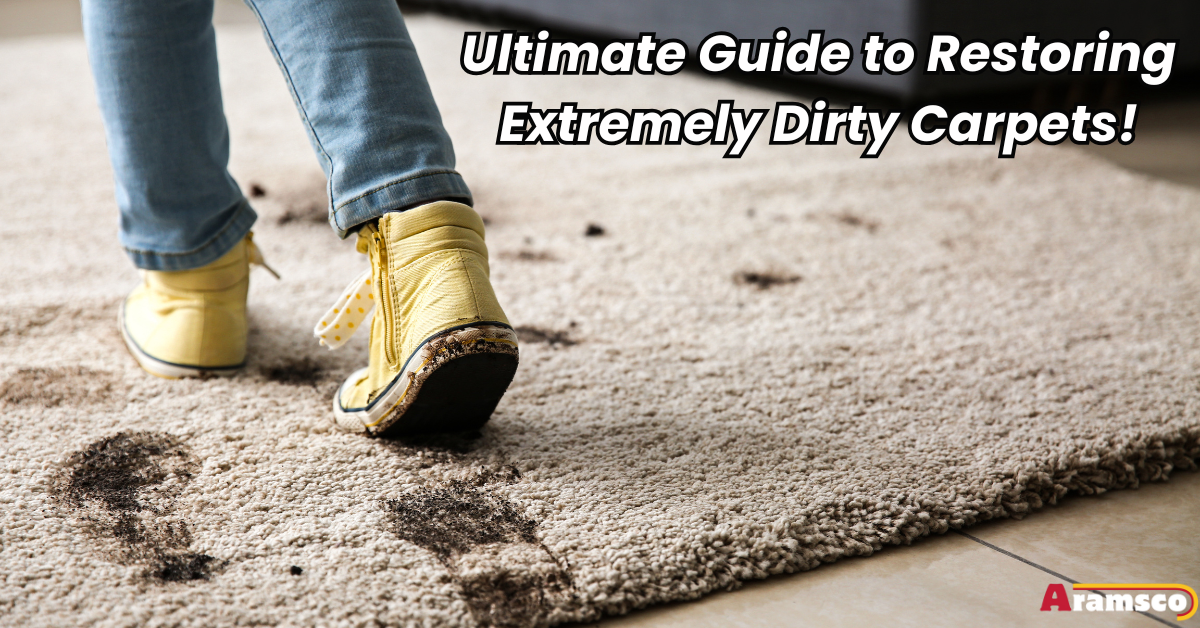
Carpets that have been neglected or heavily soiled over time can feel overwhelming to clean. But with the right steps — from removing loose soil to deep extraction — you can dramatically improve the look and hygiene of even the messiest carpet.
## ****
## **1. Remove Loose Dirt First**
Before you do anything wet, begin with **thorough dry soil removal**. Vacuum the carpet carefully to pull up as much dry grit, dust, and debris as possible. This step makes later cleaning far more effective because dry soil can abrade fibers and interfere with deep cleaning if it’s mixed with liquids. Consider multiple passes over high-traffic areas and corners to ensure you get as much loose soil up as possible.
## **2. Spot Treat Noticeable Stains**
Once the surface soil is mostly gone, take a good look at the carpet for spots or stubborn stains that won’t easily dissolve during general cleaning. Try treating these with a gentle homemade solution (for example, a diluted water-and-vinegar mix) or a targeted stain remover. Always **test any solution first in an inconspicuous area** to guard against color fading or fiber damage.
## **3. Deep Clean with a Systematic Approach**
When a carpet is severely dirty, it’s not enough to just vacuum or spot treat — you’ll want to apply a deep-cleaning method that flushes out grime and restores the appearance of the fibers:
- **Pre-treat problem areas:** Lightly spray or apply your cleaning solution on heavy-soiled areas and let it sit briefly. This helps to loosen embedded dirt before extraction.
- **Clean in sections:** Work methodically across the room, starting farthest from the exit so you don’t step on wet carpet. Move in small, overlapping sections to ensure full coverage and repeat passes if needed in deeply soiled zones.
- **Follow the right motion:** For machine cleaning, apply your cleaning mixture moving forward, then extract dirty water by pulling back. This two-step motion—spray followed by suction—extracts the most grime.
Whether you’re using a steam-type system (hot water extraction) or a carpet shampooer, the key is removing **both the soil and the dirty water**, not just redistributing it.
## **4. Rinse and Remove Residue**
If your cleaning method uses detergents or cleaning solutions, it’s important to rinse the carpet afterward. Passing clean water through the fibers and extracting again helps prevent sticky residues that attract dirt more quickly in the future.
## **5. Dry Thoroughly**
A crucial final step — especially for heavily saturated carpet — is **complete drying**. Carpets left damp can develop mildew, odors, and mold:
- Improve airflow by opening windows or using fans and dehumidifiers.
- Avoid walking on the carpet until it is fully dry.
Drying times vary widely depending on humidity and airflow, but **patience at this step pays off** in avoiding musty smells.
## **6. Maintenance After Cleaning**
Once your carpets are clean, maintenance makes future deep cleans easier:
- **Vacuum regularly** (at least once a week) to prevent soil build-up.
- **Address spills quickly** to avoid permanent staining.
- Consider establishing a **deep-clean schedule** — many experts recommend deep cleaning every 12–18 months for average homes, and more frequently if you have pets, kids, or heavy traffic.
## **Final Thoughts**
Restoring a filthy carpet doesn’t have to be intimidating. With a structured approach — removing dry soil, treating stains, deep cleaning in sections, rinsing, and drying well — you can bring even the most abused carpet back to life. Consistent maintenance afterward will make these deep cleans less frequent and much easier to manage!
*Have a blog topic you want us to discuss? Leave a comment below!*
[Carpet](https://blog.aramsco.com/tag/carpet)
- [Tweet](https://twitter.com/share)
[**BLOG HOME**](https://blog.aramsco.com/)
**Where the professionals go to learn about:**
- lead and asbestos abatement
- professional cleaning
- mold, fire, and water restoration
- concrete surface preparation
- business management
### Subscribe to Blog
Search Search Google
### Recent Posts
### Posts by Topic
- [Business (41)](https://blog.aramsco.com/tag/business)
- [Aramsco Clean (35)](https://blog.aramsco.com/tag/aramsco-clean)
- [Aramsco Restore (28)](https://blog.aramsco.com/tag/aramsco-restore)
- [carpet cleaning (27)](https://blog.aramsco.com/tag/carpet-cleaning)
- [Chemistry (19)](https://blog.aramsco.com/tag/chemistry)
- [Rugs (14)](https://blog.aramsco.com/tag/rugs)
- [Carpet (12)](https://blog.aramsco.com/tag/carpet)
- [Aramsco Surface (11)](https://blog.aramsco.com/tag/aramsco-surface)
- [target marketing (11)](https://blog.aramsco.com/tag/target-marketing)
- [Concrete (10)](https://blog.aramsco.com/tag/concrete)
- [Education (9)](https://blog.aramsco.com/tag/education)
- [deodorization (9)](https://blog.aramsco.com/tag/deodorization)
- [special agents (9)](https://blog.aramsco.com/tag/special-agents)
- [upholstery cleaning (9)](https://blog.aramsco.com/tag/upholstery-cleaning)
- [Carpet Presprays (8)](https://blog.aramsco.com/tag/carpet-presprays)
- [Tile & Grout (8)](https://blog.aramsco.com/tag/tile-grout)
- [customer service (8)](https://blog.aramsco.com/tag/customer-service)
- [encapsulation (8)](https://blog.aramsco.com/tag/encapsulation)
- [COVID-19 (7)](https://blog.aramsco.com/tag/covid-19)
- [Spotting (7)](https://blog.aramsco.com/tag/spotting)
- [Stain Removal (7)](https://blog.aramsco.com/tag/stain-removal)
- [Surface Preparation (6)](https://blog.aramsco.com/tag/surface-preparation)
- [Business Finance (5)](https://blog.aramsco.com/tag/business-finance)
- [Customer communication and storytelling (5)](https://blog.aramsco.com/tag/customer-communication-and-storytelling)
- [Grow your business (5)](https://blog.aramsco.com/tag/grow-your-business)
- [carpet protector (5)](https://blog.aramsco.com/tag/carpet-protector)
- [Equipment (4)](https://blog.aramsco.com/tag/equipment)
- [Flooring (3)](https://blog.aramsco.com/tag/flooring)
- [concrete surface preparation (3)](https://blog.aramsco.com/tag/concrete-surface-preparation)
- [sales (3)](https://blog.aramsco.com/tag/sales)
- [IICRC Classes (2)](https://blog.aramsco.com/tag/iicrc-classes)
- [Restoration (2)](https://blog.aramsco.com/tag/restoration)
- [Targeted Marketing (2)](https://blog.aramsco.com/tag/targeted-marketing)
- [Trauma Cleaning (2)](https://blog.aramsco.com/tag/trauma-cleaning)
- [Truckmount (2)](https://blog.aramsco.com/tag/truckmount)
- [carpet coloring (2)](https://blog.aramsco.com/tag/carpet-coloring)
- [Aramsco Service (1)](https://blog.aramsco.com/tag/aramsco-service)
- [Customer Acquisition (1)](https://blog.aramsco.com/tag/customer-acquisition)
- [fiber identification (1)](https://blog.aramsco.com/tag/fiber-identification)
- [news releases (1)](https://blog.aramsco.com/tag/news-releases)
- [portables (1)](https://blog.aramsco.com/tag/portables)
See all
### Blog Archive
- [Tom Forsythe (130)](https://blog.aramsco.com/author/tom-forsythe)
- [Drew Crawford (50)](https://blog.aramsco.com/author/drew-crawford)
- [Aramsco Technical Staff (26)](https://blog.aramsco.com/author/aramsco-technical-staff)
- [Scott Warrington (18)](https://blog.aramsco.com/author/scott-warrington)
- [Jared Twitchell (15)](https://blog.aramsco.com/author/jared-twitchell)
- [Alex Morrill (12)](https://blog.aramsco.com/author/alex-morrill)
- [Steve Johnson (7)](https://blog.aramsco.com/author/steve-johnson)
- [Angela Buckendorf (5)](https://blog.aramsco.com/author/angela-buckendorf)
- [Rachel Adams (4)](https://blog.aramsco.com/author/rachel-adams)
- [Ron Colling (3)](https://blog.aramsco.com/author/ron-colling)
- [Seth Gifford (2)](https://blog.aramsco.com/author/seth-gifford)
- [Nancy Macdonald (2)](https://blog.aramsco.com/author/nancy-macdonald)
- [Gregg Sargent (2)](https://blog.aramsco.com/author/gregg-sargent)
- [Angela Buckendorf & Drew Crawford (1)](https://blog.aramsco.com/author/angela-buckendorf-drew-crawford)
- [Savaana Sihapanya (1)](https://blog.aramsco.com/author/savaana-sihapanya)
- [Dane Gregory (1)](https://blog.aramsco.com/author/dane-gregory)
- [Sandra Hummel (1)](https://blog.aramsco.com/author/sandra-hummel)
- [Luke Draeger (1)](https://blog.aramsco.com/author/luke-draeger)
- [Doyle Bloss (1)](https://blog.aramsco.com/author/doyle-bloss)
- [Tim Schaelling (1)](https://blog.aramsco.com/author/tim-schaelling)
- [Lucas Whitmer (1)](https://blog.aramsco.com/author/lucas-whitmer)
- [Schyler Lewis (1)](https://blog.aramsco.com/author/schyler-lewis)
- [Drew Crawford & Alex Morrill (1)](https://blog.aramsco.com/author/drew-crawford-alex-morrill)
- [Michelle Smith (1)](https://blog.aramsco.com/author/michelle-smith)
See all
#### Current Promotions
Great deals on abatement, safety, surface preparation, and carpet cleaning equipment and chemicals!
[Click to Save](https://aramsco.com/on-sale.html)
#### Online Catalog
All the restoration, safety, cleaning and surface preparation products you need in glossy, digital print.
[See Products](https://cx.aramsco.com/?__hstc=88961988.ca7266f9997610aee14ebd89f4f37653.1557724048361.1557724048361.1557730574295.2&__hssc=88961988.1.1557730574295&__hsfp=35742670)
#### Nexus Conference
Updates on the industry's top conference. Demos, Education, Networking,
and Fun!
[Learn More](https://nexus.aramsco.com/?__hstc=88961988.ca7266f9997610aee14ebd89f4f37653.1557724048361.1557724048361.1557730574295.2&__hssc=88961988.1.1557730574295&__hsfp=35742670)
- Shop By Categories
- [Air Scrubbers](https://www.aramsco.com/equipment-instruments/negative-air-air-scrubbers.html)
- [Carpet Cleaning Chemicals](https://www.aramsco.com/chemicals/cleaning.html)
- [Cleaning Equipment](https://www.aramsco.com/equipment-instruments/cleaning-equipment.html)
- [Cleaning Tools](https://www.aramsco.com/tools-supplies/cleaning-tools-supplies.html)
- [Concrete Grinding](https://aramsco.com/equipment-instruments/grinders-polishers.html)
- [Disinfectants & Antimicrobials](https://www.aramsco.com/chemicals/disinfectants-antimicrobials.html)
- [Drying Equipment](https://www.aramsco.com/equipment-instruments/drying.html)
- [Floor Scrapers](https://www.aramsco.com/equipment-instruments/scrapers.html)
- [Mastic Removers](https://www.aramsco.com/chemicals/adhesive-coating-removers.html)
- [Odor Neutralizers](https://www.aramsco.com/chemicals/odor-control.html)
- [Poly Sheeting](https://www.aramsco.com/plastics-adhesives/poly-sheeting.html)
- [Respirators](https://www.aramsco.com/safety-ppe/respirators-respiratory-protection.html)
- [Shot Blasting](https://www.aramsco.com/equipment-instruments/shot-abrasive-blasting.html)
- [Thermal Imaging](https://www.aramsco.com/equipment-instruments/meters-testing/infrared-temperature.html)
- [Vacuums](https://www.aramsco.com/equipment-instruments/vacuums.html)
- Resources
- [Pro's Corner](https://blog.aramsco.com)
- [Classifieds](https://classifieds.aramsco.com/)
- [Monthly Ad](https://cx.aramsco.com/)
- [Education Schedule](https://www.cvent.com/c/calendar/ab53c6cb-fee0-44a6-a384-c51a2a4b32c0)
- [Equipment Financing](https://aztecfinancial.com/)
- [Equipment Rental](https://www.aramsco.com/training-rentals-repairs)
- [Equipment Repair](https://www.aramsco.com/training-rentals-repairs)
- [Site Map](https://www.aramsco.com/training-rentals-repairs)
- Company Info
- [About Us](https://www.aramsco.com/aboutus)
- [Careers](https://workforcenow.adp.com/jobs/apply/posting.html?client=aramsco&ccId=19000101_000001&type=MP&lang=en_US)
- [Contact Us](https://www.aramsco.com/contact)
- [News](https://www.aramsco.com/news)
- OUR BRANDS
- [Aztec Financial](https://aztecfinancial.com/)
- [NSS](https://nssusa.com/)
- [Safety Express](http://safetyexpress.com/?__hstc=88961988.ca7266f9997610aee14ebd89f4f37653.1557724048361.1557724048361.1557730574295.2&__hssc=88961988.2.1557730574295&__hsfp=35742670)
- Policies
- [Privacy Policy](https://www.aramsco.com/privacy-policy)
- [Return Policy](https://www.aramsco.com/terms-conditions#returns)
- [Shipping Policy](https://www.aramsco.com/terms-conditions#shipping)
- [Terms & Conditions](https://www.aramsco.com/terms-conditions)
- Corporate Location
- Find a location Near You
- [Location image](https://www.aramsco.com/locations)
Corporate Location
- Aramsco, Inc.
Five Radnor Corporate Center
100 Matsonford Road Suite 510
Radnor, PA 19087
- (800) 767-6933
- customer.service@aramsco.com
Copyright © 2025 Aramsco. All rights reserved.
```json
{
"@context" : "https://schema.org",
"@type" : "BlogPosting",
"author" : {
"@type" : "Person",
"name" : "Aramsco Technical Staff",
"url" : "https://blog.aramsco.com/author/aramsco-technical-staff"
},
"dateModified" : "2026-01-09T19:42:40.664Z",
"datePublished" : "2026-01-09T19:42:40.000Z",
"headline" : "Ultimate Guide to Restoring Extremely Dirty Carpets!",
"image" : [ "https://blog.aramsco.com/hubfs/Copy%20of%20Copy%20of%20blog.png" ],
"mainEntityOfPage" : {
"@id" : "https://blog.aramsco.com/ultimate-guide-to-restoring-extremely-dirty-carpets",
"@type" : "WebPage"
},
"publisher" : {
"@type" : "Organization",
"logo" : {
"@type" : "ImageObject",
"url" : "https://blog.aramsco.com/hubfs/Logos/Aramsco%20R%20Family%20-%20Equipped%20for%20Success.png"
},
"name" : "Aramsco"
}
}
```