---
title: Why Dust Containment Poles Are Essential for Every Remediation Job
description: Learn why dust containment poles are essential for remediation jobs, helping control airborne contaminants, improve safety, ensure compliance, and protect property.
image: https://blog.aramsco.com/hubfs/Copy%20of%20Copy%20of%20Copy%20of%20Copy%20of%20Copy%20of%20Copy%20of%20How%20to%20Maintain%20Your%20Equipment%20to%20Extend%20Lifespan.png
---
- [Home](https://aramsco.com)
- [Pro's Corner](https://blog.aramsco.com)
[](https://www.aramsco.com/)
- [Home](https://aramsco.com)
- [Pro's Corner](https://blog.aramsco.com)
- Account
- [locations](http://aramsco-live.epicorcommerce.com/locations/)
- [education](http://aramsco-live.epicorcommerce.com/education/)
- [about us](http://aramsco-live.epicorcommerce.com/aboutus/)
# Pro's Corner
## [Why Dust Containment Poles Are Essential for Every Remediation Job](https://blog.aramsco.com/why-dust-containment-poles-are-essential-for-every-remediation-job)
Posted by Aramsco Technical Staff on Jun 25th 2026
Why Dust Containment Poles Are Essential for Every Remediation Job
5:19
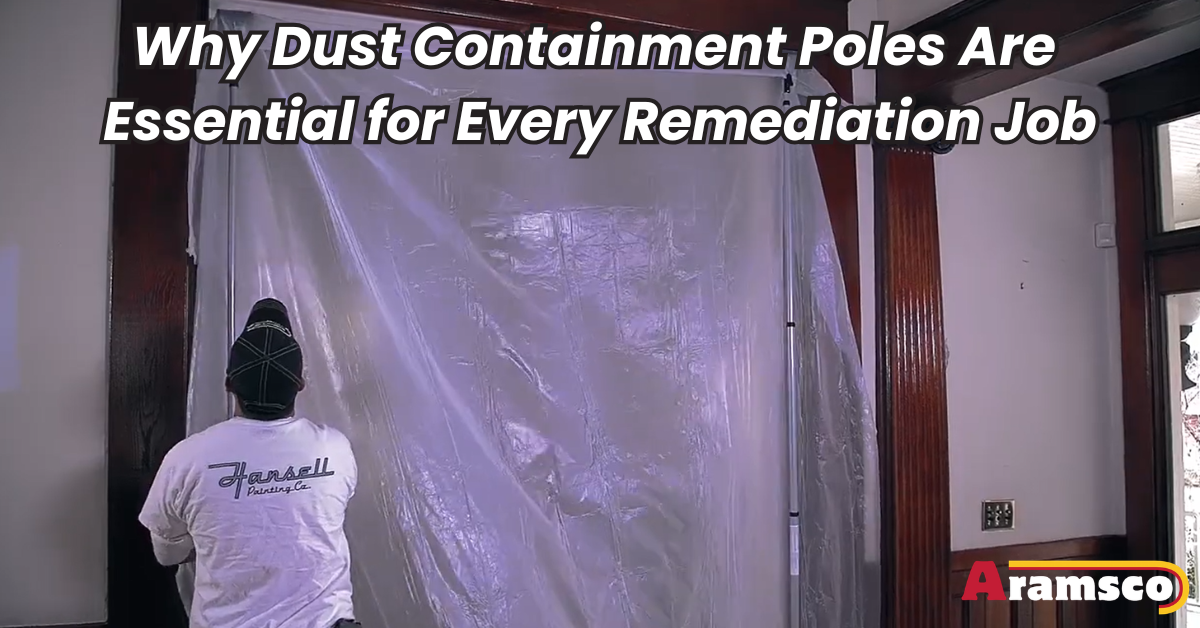
**Why Dust Containment Poles Are Essential for Every Remediation Job**
In the restoration and remediation world, speed matters, but so does control. Whether responding to water damage, fire and smoke cleanup, or mold remediation, proper containment is critical – not just for the success of the job, but for the health and safety of occupants and technicians alike.
One of the most effective and efficient ways to create a controlled environment is by using dust containment poles. These poles are used to build secure, floor‑to‑ceiling containment barriers in minutes, creating safer and cleaner work zones.
**Why Containment Matters in Remediation**
Remediation projects inherently disturb materials that can release hazardous particles into the air – mold spores, soot, silica dust, and other contaminants. Once airborne, these contaminants can travel far beyond the immediate work area, potentially affecting occupants, adjacent rooms or even the HVAC system. In healthcare facilities, schools and occupied commercial spaces, even minor contamination can lead to significant health concerns or regulatory issues.
Without proper containment, a small remediation project can quickly escalate into a larger problem, resulting in additional cleanup, liability risks and delays.
**What Are Dust Containment Poles?**
Dust containment poles, such as Trimaco’s E-Z Up Poles, are adjustable, tension-mounted poles used to create temporary barriers with plastic sheeting. They allow contractors to quickly construct containment walls without the need for permanent fixtures or damage to existing structures.
These systems are designed for flexibility, allowing teams to:
- Section off work zones
- Create negative air containment spaces
- Prevent particle migration
Paired with other tools like HEPA air scrubbers and negative air machines, containment poles are a foundational component of any professional remediation setup.
**Key Benefits of Dust Containment Poles**
**1. Effective Containment and Air Control**
The primary benefit of dust containment poles is their ability to prevent cross-contamination. By sealing off the work area, they help ensure that airborne particles remain confined where they can be properly filtered and removed.
This is especially critical in environments where sensitive populations may be present, such as hospitals or assisted living facilities.
**2. Improved Safety for Workers and Occupants**
Proper containment protects not only building occupants but also remediation professionals themselves. By limiting the spread of hazardous materials, workers can operate in more controlled conditions, reducing exposure risks.
Containment also helps maintain clearer visibility and better air quality, improving job site safety and efficiency.
**3. Regulatory Compliance**
Many remediation and restoration projects must adhere to strict industry standards, including guidelines from organizations like OSHA and the EPA. These standards often require containment measures when dealing with hazardous materials such as mold, lead or asbestos.
Dust containment poles provide a practical and compliant solution for establishing required barriers and helping contractors meet these regulations.
**4. Faster Setup and Greater Efficiency**
Dust containment poles are quick to install and dismantle. This not only ensures you can act fast as conditions evolve, but also reduces setup time, lowers labor costs and increases overall job efficiency.
Dust containment poles feature a telescoping design that adjusts to different ceiling heights and room layouts. For instance, Trimaco offers E-Z Up Poles that fit [12 foot](https://www.aramsco.com/1630-3327-trimaco-12-e-z-up-54732-dust-containment-poles-steel-foot-2-per-pack132330.html) to [20 foot](https://www.aramsco.com/1673-3521-trimaco-20-e-z-up-54738-dust-containment-poles-2-per-pack-trimaco132753.html) ceilings, making them a versatile solution for both small and large projects.
**5. Protection of Property and Reputation**
By preventing dust from spreading to unaffected areas, contractors can avoid secondary damage, reduce cleanup time and maintain a higher level of customer satisfaction throughout the job.
**Best Practices for Using Dust Containment Poles**
To maximize effectiveness, dust containment poles should be used as part of a broader containment strategy:
- Use high-quality plastic sheeting to create airtight barriers
- Seal edges and seams with tape to minimize leakage
- Incorporate negative air pressure using HEPA-filtered air scrubbers
- Establish proper entry points with high-quality zippers
- Inspect containment regularly to ensure integrity throughout the project
When used correctly, these systems significantly reduce the risk of contamination and improve overall job performance.
**The Bottom Line**
Dust containment poles may seem like a simple tool, but their impact on remediation projects is substantial. They provide an efficient, cost-effective way to control airborne contaminants, protect health and safety, and ensure compliance with industry standards.
For remediation professionals, investing in reliable containment solutions like Trimaco’s E-Z Up Poles is not just best practice – it's essential. By incorporating dust containment poles into every appropriate job, contractors can deliver cleaner, safer and more professional results every time.
*This blog was submitted by the Trimaco team. *
[Aramsco Restore](https://blog.aramsco.com/tag/aramsco-restore)
- [Tweet](https://twitter.com/share)
[**BLOG HOME**](https://blog.aramsco.com/)
**Where the professionals go to learn about:**
- lead and asbestos abatement
- professional cleaning
- mold, fire, and water restoration
- concrete surface preparation
- business management
### Subscribe to Blog
Search Search Google
### Recent Posts
### Posts by Topic
- [Business (41)](https://blog.aramsco.com/tag/business)
- [Aramsco Clean (35)](https://blog.aramsco.com/tag/aramsco-clean)
- [Aramsco Restore (28)](https://blog.aramsco.com/tag/aramsco-restore)
- [carpet cleaning (27)](https://blog.aramsco.com/tag/carpet-cleaning)
- [Chemistry (19)](https://blog.aramsco.com/tag/chemistry)
- [Rugs (14)](https://blog.aramsco.com/tag/rugs)
- [Carpet (12)](https://blog.aramsco.com/tag/carpet)
- [Aramsco Surface (11)](https://blog.aramsco.com/tag/aramsco-surface)
- [target marketing (11)](https://blog.aramsco.com/tag/target-marketing)
- [Concrete (10)](https://blog.aramsco.com/tag/concrete)
- [Education (9)](https://blog.aramsco.com/tag/education)
- [deodorization (9)](https://blog.aramsco.com/tag/deodorization)
- [special agents (9)](https://blog.aramsco.com/tag/special-agents)
- [upholstery cleaning (9)](https://blog.aramsco.com/tag/upholstery-cleaning)
- [Carpet Presprays (8)](https://blog.aramsco.com/tag/carpet-presprays)
- [Tile & Grout (8)](https://blog.aramsco.com/tag/tile-grout)
- [customer service (8)](https://blog.aramsco.com/tag/customer-service)
- [encapsulation (8)](https://blog.aramsco.com/tag/encapsulation)
- [COVID-19 (7)](https://blog.aramsco.com/tag/covid-19)
- [Spotting (7)](https://blog.aramsco.com/tag/spotting)
- [Stain Removal (7)](https://blog.aramsco.com/tag/stain-removal)
- [Surface Preparation (6)](https://blog.aramsco.com/tag/surface-preparation)
- [Business Finance (5)](https://blog.aramsco.com/tag/business-finance)
- [Customer communication and storytelling (5)](https://blog.aramsco.com/tag/customer-communication-and-storytelling)
- [Grow your business (5)](https://blog.aramsco.com/tag/grow-your-business)
- [carpet protector (5)](https://blog.aramsco.com/tag/carpet-protector)
- [Equipment (4)](https://blog.aramsco.com/tag/equipment)
- [Flooring (3)](https://blog.aramsco.com/tag/flooring)
- [concrete surface preparation (3)](https://blog.aramsco.com/tag/concrete-surface-preparation)
- [sales (3)](https://blog.aramsco.com/tag/sales)
- [IICRC Classes (2)](https://blog.aramsco.com/tag/iicrc-classes)
- [Restoration (2)](https://blog.aramsco.com/tag/restoration)
- [Targeted Marketing (2)](https://blog.aramsco.com/tag/targeted-marketing)
- [Trauma Cleaning (2)](https://blog.aramsco.com/tag/trauma-cleaning)
- [Truckmount (2)](https://blog.aramsco.com/tag/truckmount)
- [carpet coloring (2)](https://blog.aramsco.com/tag/carpet-coloring)
- [Aramsco Service (1)](https://blog.aramsco.com/tag/aramsco-service)
- [Customer Acquisition (1)](https://blog.aramsco.com/tag/customer-acquisition)
- [fiber identification (1)](https://blog.aramsco.com/tag/fiber-identification)
- [news releases (1)](https://blog.aramsco.com/tag/news-releases)
- [portables (1)](https://blog.aramsco.com/tag/portables)
See all
### Blog Archive
- [Tom Forsythe (130)](https://blog.aramsco.com/author/tom-forsythe)
- [Drew Crawford (50)](https://blog.aramsco.com/author/drew-crawford)
- [Aramsco Technical Staff (26)](https://blog.aramsco.com/author/aramsco-technical-staff)
- [Scott Warrington (18)](https://blog.aramsco.com/author/scott-warrington)
- [Jared Twitchell (15)](https://blog.aramsco.com/author/jared-twitchell)
- [Alex Morrill (12)](https://blog.aramsco.com/author/alex-morrill)
- [Steve Johnson (7)](https://blog.aramsco.com/author/steve-johnson)
- [Angela Buckendorf (5)](https://blog.aramsco.com/author/angela-buckendorf)
- [Rachel Adams (4)](https://blog.aramsco.com/author/rachel-adams)
- [Ron Colling (3)](https://blog.aramsco.com/author/ron-colling)
- [Seth Gifford (2)](https://blog.aramsco.com/author/seth-gifford)
- [Nancy Macdonald (2)](https://blog.aramsco.com/author/nancy-macdonald)
- [Gregg Sargent (2)](https://blog.aramsco.com/author/gregg-sargent)
- [Angela Buckendorf & Drew Crawford (1)](https://blog.aramsco.com/author/angela-buckendorf-drew-crawford)
- [Savaana Sihapanya (1)](https://blog.aramsco.com/author/savaana-sihapanya)
- [Dane Gregory (1)](https://blog.aramsco.com/author/dane-gregory)
- [Sandra Hummel (1)](https://blog.aramsco.com/author/sandra-hummel)
- [Luke Draeger (1)](https://blog.aramsco.com/author/luke-draeger)
- [Doyle Bloss (1)](https://blog.aramsco.com/author/doyle-bloss)
- [Tim Schaelling (1)](https://blog.aramsco.com/author/tim-schaelling)
- [Lucas Whitmer (1)](https://blog.aramsco.com/author/lucas-whitmer)
- [Schyler Lewis (1)](https://blog.aramsco.com/author/schyler-lewis)
- [Drew Crawford & Alex Morrill (1)](https://blog.aramsco.com/author/drew-crawford-alex-morrill)
- [Michelle Smith (1)](https://blog.aramsco.com/author/michelle-smith)
See all
#### Current Promotions
Great deals on abatement, safety, surface preparation, and carpet cleaning equipment and chemicals!
[Click to Save](https://aramsco.com/on-sale.html)
#### Online Catalog
All the restoration, safety, cleaning and surface preparation products you need in glossy, digital print.
[See Products](https://cx.aramsco.com/?__hstc=88961988.ca7266f9997610aee14ebd89f4f37653.1557724048361.1557724048361.1557730574295.2&__hssc=88961988.1.1557730574295&__hsfp=35742670)
#### Nexus Conference
Updates on the industry's top conference. Demos, Education, Networking,
and Fun!
[Learn More](https://nexus.aramsco.com/?__hstc=88961988.ca7266f9997610aee14ebd89f4f37653.1557724048361.1557724048361.1557730574295.2&__hssc=88961988.1.1557730574295&__hsfp=35742670)
- Shop By Categories
- [Air Scrubbers](https://www.aramsco.com/equipment-instruments/negative-air-air-scrubbers.html)
- [Carpet Cleaning Chemicals](https://www.aramsco.com/chemicals/cleaning.html)
- [Cleaning Equipment](https://www.aramsco.com/equipment-instruments/cleaning-equipment.html)
- [Cleaning Tools](https://www.aramsco.com/tools-supplies/cleaning-tools-supplies.html)
- [Concrete Grinding](https://aramsco.com/equipment-instruments/grinders-polishers.html)
- [Disinfectants & Antimicrobials](https://www.aramsco.com/chemicals/disinfectants-antimicrobials.html)
- [Drying Equipment](https://www.aramsco.com/equipment-instruments/drying.html)
- [Floor Scrapers](https://www.aramsco.com/equipment-instruments/scrapers.html)
- [Mastic Removers](https://www.aramsco.com/chemicals/adhesive-coating-removers.html)
- [Odor Neutralizers](https://www.aramsco.com/chemicals/odor-control.html)
- [Poly Sheeting](https://www.aramsco.com/plastics-adhesives/poly-sheeting.html)
- [Respirators](https://www.aramsco.com/safety-ppe/respirators-respiratory-protection.html)
- [Shot Blasting](https://www.aramsco.com/equipment-instruments/shot-abrasive-blasting.html)
- [Thermal Imaging](https://www.aramsco.com/equipment-instruments/meters-testing/infrared-temperature.html)
- [Vacuums](https://www.aramsco.com/equipment-instruments/vacuums.html)
- Resources
- [Pro's Corner](https://blog.aramsco.com)
- [Classifieds](https://classifieds.aramsco.com/)
- [Monthly Ad](https://cx.aramsco.com/)
- [Education Schedule](https://www.cvent.com/c/calendar/ab53c6cb-fee0-44a6-a384-c51a2a4b32c0)
- [Equipment Financing](https://aztecfinancial.com/)
- [Equipment Rental](https://www.aramsco.com/training-rentals-repairs)
- [Equipment Repair](https://www.aramsco.com/training-rentals-repairs)
- [Site Map](https://www.aramsco.com/training-rentals-repairs)
- Company Info
- [About Us](https://www.aramsco.com/aboutus)
- [Careers](https://workforcenow.adp.com/jobs/apply/posting.html?client=aramsco&ccId=19000101_000001&type=MP&lang=en_US)
- [Contact Us](https://www.aramsco.com/contact)
- [News](https://www.aramsco.com/news)
- OUR BRANDS
- [Aztec Financial](https://aztecfinancial.com/)
- [NSS](https://nssusa.com/)
- [Safety Express](http://safetyexpress.com/?__hstc=88961988.ca7266f9997610aee14ebd89f4f37653.1557724048361.1557724048361.1557730574295.2&__hssc=88961988.2.1557730574295&__hsfp=35742670)
- Policies
- [Privacy Policy](https://www.aramsco.com/privacy-policy)
- [Return Policy](https://www.aramsco.com/terms-conditions#returns)
- [Shipping Policy](https://www.aramsco.com/terms-conditions#shipping)
- [Terms & Conditions](https://www.aramsco.com/terms-conditions)
- Corporate Location
- Find a location Near You
- [Location image](https://www.aramsco.com/locations)
Corporate Location
- Aramsco, Inc.
Five Radnor Corporate Center
100 Matsonford Road Suite 510
Radnor, PA 19087
- (800) 767-6933
- customer.service@aramsco.com
Copyright © 2025 Aramsco. All rights reserved.
```json
{
"@context" : "https://schema.org",
"@type" : "BlogPosting",
"author" : {
"@type" : "Person",
"name" : "Aramsco Technical Staff",
"url" : "https://blog.aramsco.com/author/aramsco-technical-staff"
},
"dateModified" : "2026-06-25T19:00:47.488Z",
"datePublished" : "2026-06-25T19:00:47.000Z",
"headline" : "Why Dust Containment Poles Are Essential for Every Remediation Job",
"image" : [ "https://blog.aramsco.com/hubfs/Copy%20of%20Copy%20of%20Copy%20of%20Copy%20of%20Copy%20of%20Copy%20of%20How%20to%20Maintain%20Your%20Equipment%20to%20Extend%20Lifespan.png" ],
"mainEntityOfPage" : {
"@id" : "https://blog.aramsco.com/why-dust-containment-poles-are-essential-for-every-remediation-job",
"@type" : "WebPage"
},
"publisher" : {
"@type" : "Organization",
"logo" : {
"@type" : "ImageObject",
"url" : "https://blog.aramsco.com/hubfs/Logos/Aramsco%20R%20Family%20-%20Equipped%20for%20Success.png"
},
"name" : "Aramsco"
}
}
```